
Most UAE businesses running marketing campaigns have access to more data than they use. The problem is not a shortage of metrics — it is the absence of a structured way to connect those metrics to business decisions. A marketing KPI dashboard solves this by organizing the most relevant performance indicators into a single view that answers the questions business owners and marketing managers in the UAE actually ask: are we generating enough qualified leads, at an acceptable cost, from the channels we are investing in?
This guide covers what a marketing KPI dashboard for UAE businesses should include, how to select the right KPIs for your specific business model, and how to structure the dashboard so it drives decisions rather than just reporting activity. It pairs with our guides on marketing performance reporting, the marketing ROI dashboard, and the agency reporting dashboard vs in-house reports, extending those foundations with a specific focus on KPI selection and dashboard architecture for the UAE market.
It connects to analytics and reporting services, BI and performance dashboards, CRM integration, and PPC campaign tracking — because a KPI dashboard that does not pull from all of these sources will always present an incomplete picture of marketing performance.
What is a marketing KPI dashboard and why does it matter for UAE businesses?
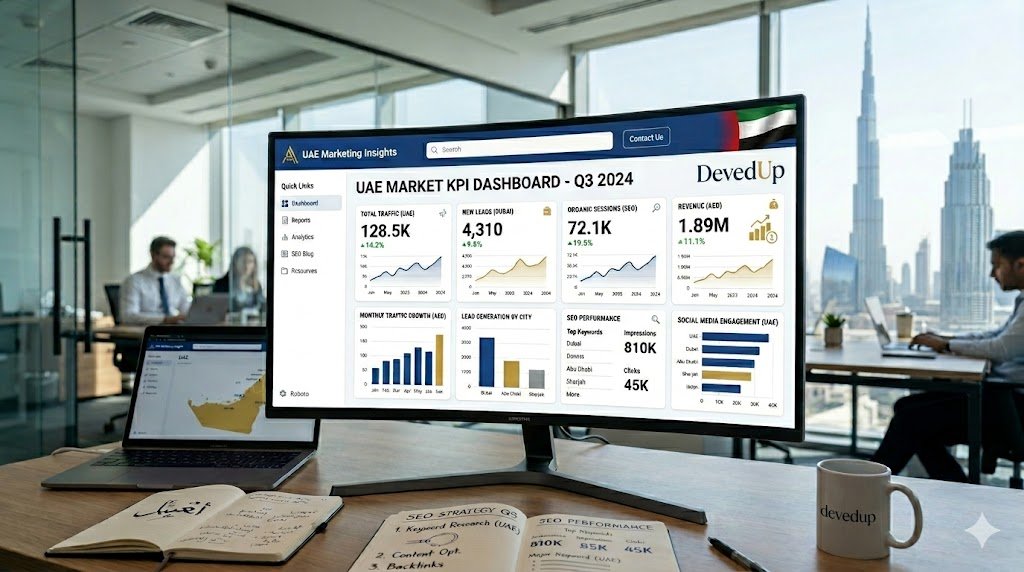
A marketing KPI dashboard is a structured visual display of the key performance indicators that reflect marketing effectiveness and business outcomes. Unlike a general analytics report, a KPI dashboard is built around a defined set of metrics that are directly connected to business goals, displayed in a format that allows quick interpretation and comparison against targets.
For UAE businesses, the KPI dashboard serves a practical purpose: the Dubai and wider UAE market is competitive across most sectors, and marketing investment decisions need to be data-informed rather than intuitive. A business that can see which campaigns generate qualified leads, which channels produce clients at the lowest acquisition cost, and where conversion is breaking down in the funnel is in a position to allocate budget more intelligently than a competitor relying on monthly PDF reports or platform-native dashboards that show activity without business context.
The difference between a KPI dashboard and a metrics dashboard
Not all performance metrics are KPIs. A metric is any measurable value — page views, email open rate, impressions, click-through rate. A key performance indicator is a metric that is directly connected to a key business objective and has a defined target. The distinction matters because a dashboard full of metrics without targets is just a data display. A dashboard built around KPIs with defined targets tells you immediately whether performance is on track, below expectations, or exceeding them.
For a UAE service business, page views are a metric. Qualified leads generated from organic search per month, measured against a monthly target, is a KPI. Both numbers might appear on the same dashboard, but only one of them drives a decision.
Which KPIs belong in a UAE marketing dashboard?
The right KPIs depend on your business model and your primary growth objectives. The framework below covers the most universally relevant categories for UAE businesses running digital marketing across multiple channels.
Lead generation KPIs
- Total qualified leads per month — from CRM, not platform conversion counts
- Lead volume by channel — organic, paid, email, referral, direct
- Lead quality rate — percentage of all leads that meet qualification criteria
- Lead response time — average minutes from lead creation to first sales contact
Cost efficiency KPIs
- Cost per lead (CPL) by channel — total channel spend divided by qualified leads from that channel
- Cost per acquired client (CAC) — total marketing spend divided by new clients in the period
- Marketing ROI — revenue attributed to marketing divided by total marketing spend
- Customer lifetime value to CAC ratio — indicates long-term profitability of acquisition cost
Funnel conversion KPIs
- Website visit-to-lead conversion rate — percentage of visitors who become leads
- Lead-to-qualified-conversation rate — percentage of leads that result in a sales meeting
- Proposal-to-close rate — percentage of proposals that become clients
- Overall funnel conversion rate — percentage of visitors who eventually become clients
Campaign performance KPIs
- Return on ad spend (ROAS) — revenue generated per dirham spent on paid advertising
- Landing page conversion rate by campaign — identifies which campaigns generate efficient leads
- Organic traffic to commercial pages — sessions on service pages from organic search
- Keyword ranking movement — week-over-week change for target commercial keywords
Pipeline and revenue KPIs
- Total pipeline value — combined deal value of all active opportunities in the CRM
- Pipeline by stage — value and volume at each pipeline stage
- Average deal velocity — average days from first contact to close
- Revenue attributed to marketing — closed won deals where first contact came from a marketing channel
How to set KPI targets for a UAE marketing dashboard
KPI targets should be based on historical performance where available, industry benchmarks where historical data is limited, and the business’s revenue targets worked backwards through the funnel. The backwards calculation is the most practically useful approach for most UAE businesses:
- Start with the monthly revenue target
- Divide by average deal value to get the required number of new clients
- Divide by the expected close rate to get the required number of proposals
- Divide by the proposal-to-meeting conversion rate to get the required number of qualified meetings
- Divide by the lead-to-meeting conversion rate to get the required number of qualified leads
- Divide by the visit-to-lead conversion rate to get the required monthly website traffic
This calculation produces a set of interconnected KPI targets that flow from the revenue goal rather than being set arbitrarily. When performance falls short at any stage of the funnel, the dashboard immediately shows which conversion rate needs improvement.
How to structure the KPI dashboard for clarity and decision-making
| Dashboard section | KPIs included | Review frequency | Primary decision it supports |
|---|---|---|---|
| Lead generation overview | Total qualified leads, lead by channel, lead quality rate | Weekly | Channel investment allocation |
| Cost efficiency | CPL by channel, CAC, marketing ROI | Monthly | Budget reallocation decisions |
| Funnel conversion | Visit-to-lead, lead-to-meeting, proposal-to-close | Monthly | Where to focus conversion improvement |
| Campaign performance | ROAS, landing page CVR, organic traffic to service pages | Weekly | Campaign optimization and scaling |
| Pipeline and revenue | Pipeline value, deal velocity, revenue attributed to marketing | Weekly / monthly | Revenue forecast and pipeline health |
Common mistakes in UAE marketing KPI dashboards
The most common mistake is including too many metrics without defining which are KPIs and which are supporting context. A dashboard with thirty metrics and no targets is harder to act on than a dashboard with ten KPIs and clear red/amber/green status indicators. Start with fewer, better-defined KPIs and add supporting metrics only when they are needed to explain why a KPI is off target.
The second most common mistake is using platform-reported conversions as the source of truth for lead volume. Google Ads reports conversions; your CRM reports qualified leads. These numbers are rarely the same, because ad platform conversions include bot traffic, duplicate submissions, and unqualified inquiries that a salesperson immediately disqualifies. The KPI dashboard should pull lead data from the CRM, not from the ad platform, for lead volume and quality metrics.
A third mistake is building the dashboard without involving the sales team in defining what a “qualified lead” means. Marketing and sales must agree on this definition for lead quality KPIs to be meaningful. Without shared definitions, the dashboard creates disagreement rather than alignment.
Ready to build a marketing KPI dashboard for your UAE business?
DevedUp Business & Marketing builds marketing KPI dashboards for UAE businesses that connect Google Ads, SEO, CRM, and analytics data into a structured decision-support system with defined targets and clear performance visibility. If you want to understand what the right KPI framework and dashboard structure would look like for your business, contact the team for an initial review.
Frequently asked questions
What is a marketing KPI dashboard?
A marketing KPI dashboard is a structured visual display of the key performance indicators that reflect marketing effectiveness and business outcomes. Unlike a general analytics view, it shows a defined set of metrics with targets, updated regularly from connected data sources, that directly support marketing and business decisions.
How many KPIs should a UAE marketing dashboard have?
Between eight and fifteen KPIs is typically sufficient for most UAE businesses. More than twenty KPIs reduces rather than improves decision clarity. Start with the five to eight metrics most directly connected to your revenue targets, add supporting metrics only when they are needed to explain why a primary KPI is underperforming.
How do I connect CRM data to a marketing KPI dashboard in the UAE?
Most major CRM platforms integrate with reporting tools through native connectors or APIs. HubSpot connects natively to Google Looker Studio. Salesforce and Pipedrive can be connected through middleware like Zapier or direct API. The integration passes lead volume, pipeline stage, close rate, and revenue data from the CRM to the dashboard, making it possible to calculate cost per acquired client and marketing ROI by channel.
What tool should UAE businesses use to build a marketing KPI dashboard?
Google Looker Studio is the most practical starting point for most UAE small to mid-size businesses. It connects natively to Google Ads, GA4, and Search Console for free, supports custom calculated metrics, and requires no technical expertise to build basic dashboards. For more complex requirements involving multiple CRM integrations or advanced data modeling, Power BI or Tableau provide greater capability at higher cost and complexity.
What KPIs should be on a marketing KPI dashboard?
A marketing KPI dashboard should cover five categories: lead generation (qualified leads, leads by channel, lead quality rate), cost efficiency (cost per lead, CAC, marketing ROI), funnel conversion (visit-to-lead, lead-to-meeting, proposal-to-close), campaign performance (ROAS, landing page conversion, organic traffic), and pipeline and revenue (pipeline value, deal velocity, marketing-attributed revenue). Each KPI should have a defined target so the dashboard shows whether performance is on track.