
AI chatbot development in Dubai has moved beyond proof-of-concept territory. Businesses across the UAE are deploying AI chatbots that handle real workloads: qualifying leads from website traffic, answering customer questions in Arabic and English, booking appointments, routing support requests, and reducing the manual effort required to manage high inquiry volumes. The technology is mature enough to deliver measurable operational value for the right use cases — the question is which use cases those are for your specific business.
This guide covers the most practical business use cases for AI chatbot development in the UAE, what each application involves technically and operationally, and how to evaluate which use case would produce the most immediate return for your business. It connects to chatbot and assistant development, AI agent development, CRM integration, workflow automation, and lead generation — because chatbots that are not connected to these systems produce conversations without business outcomes.
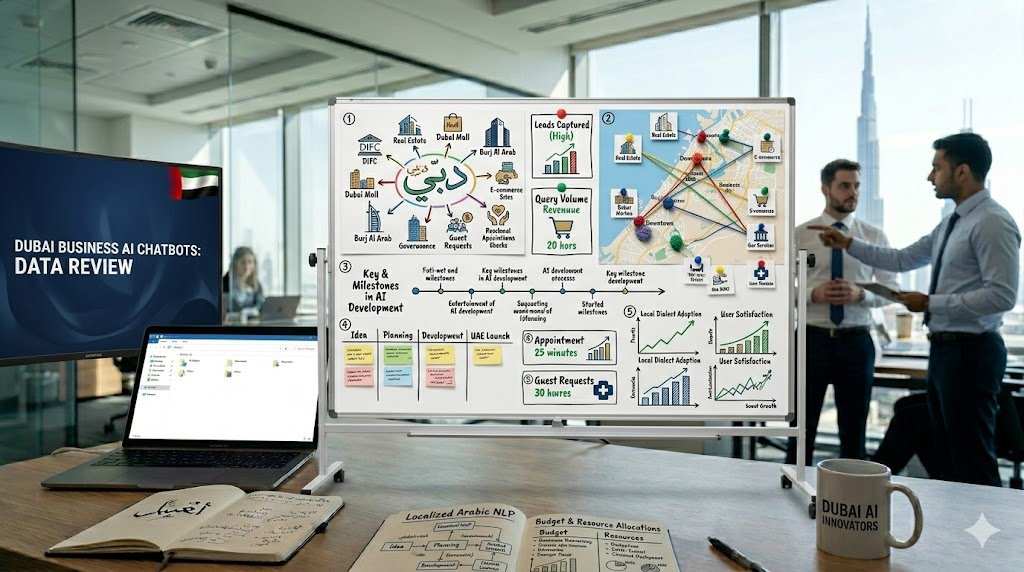
Use case 1: Lead generation and qualification on the website
Lead qualification on the website is the most common entry point for AI chatbot development in the UAE. For Dubai businesses running digital marketing campaigns, an AI chatbot on the website or landing page captures and qualifies leads at the moment of highest intent. Rather than requiring a visitor to fill out a static form and wait for a response, the chatbot engages them in a short qualifying conversation, collects the relevant information, scores the lead based on the responses, and either books a call immediately or routes the lead to the CRM with a sales task assigned.
The business impact is speed: leads contacted within minutes of expressing interest convert at significantly higher rates than leads that wait hours for a human response. For businesses running Google Ads or SEO campaigns that drive significant traffic, a chatbot that engages every visitor immediately multiplies the return from existing traffic without additional ad spend. This is the foundation of using an AI chatbot for lead generation rather than passive form capture.
Use case 2: Customer service and FAQ automation
FAQ automation is one of the highest-volume use cases in AI chatbot development. In most Dubai service businesses, a significant proportion of incoming customer inquiries involve the same questions: what are your prices, how long does it take, what is included, how do I cancel or reschedule, where are you located. An AI chatbot trained on this information can handle these inquiries automatically, 24 hours a day, without requiring a human agent to respond to each one individually.
For businesses with high inquiry volumes, the reduction in manual handling time is immediate and measurable. The chatbot handles the routine questions; human agents handle the complex, sensitive, or high-value interactions that require judgment. This division of labor allows the support team to serve more clients without proportional headcount growth.
Use case 3: Appointment booking and scheduling automation
Scheduling is another area where AI chatbot development pays back quickly. Medical clinics, legal offices, consultancies, beauty salons, and service businesses of all types in Dubai spend significant time managing appointment bookings manually: confirming availability, sending reminders, handling cancellations, and rebooking. An AI chatbot connected to a calendar system can handle the entire booking flow conversationally — checking availability in real time, confirming appointments, sending reminders, and processing cancellations — without any human involvement for routine scheduling.
For medical and healthcare businesses in the UAE, this is a particularly high-impact use case. Medical practices that handle appointment inquiries through manual WhatsApp or phone calls can reduce administrative workload significantly while improving patient experience through faster, more consistent responses.
Use case 4: WhatsApp chatbot for UAE businesses
WhatsApp is the dominant messaging platform in the UAE. For Dubai businesses, a WhatsApp chatbot extends the automation capabilities of a website chatbot to the channel where most UAE customers actually communicate. WhatsApp Business API integration allows AI chatbots to handle incoming messages, send automated responses, qualify leads, book appointments, and route complex requests to human agents, all within the messaging app that UAE customers already use daily.
WhatsApp AI chatbot development in Dubai requires access to the WhatsApp Business API (typically through an approved Business Solution Provider) and a chatbot architecture that handles the specific conversational patterns of WhatsApp messaging, which differs from website chat in session structure and user expectation. For a deeper comparison, see our guide on WhatsApp chatbot vs a website chatbot.
Use case 5: Internal operations and employee support
AI chatbot development is not limited to customer-facing applications. Internal chatbots in Dubai businesses handle employee requests that currently go to HR, IT, or operations teams: leave requests, policy questions, expense submission queries, IT support triage, and onboarding information for new employees. An internal chatbot connected to company documentation and HR systems reduces the volume of routine internal requests that require human attention.
Use case 6: E-commerce support and order management
E-commerce support is a natural fit for AI chatbot development. For UAE e-commerce businesses, an AI chatbot handles the support workload that scales with order volume: order status queries, return and exchange requests, delivery tracking, product questions, and refund processing. As platforms like Shopify-based stores in the UAE grow their order volumes, the support workload grows proportionally. A chatbot connected to the order management system resolves the majority of routine support tickets without human involvement.
Comparing AI chatbot development use cases for Dubai businesses
| Use case | Best suited for | Key integration needed | Estimated ROI timeline |
|---|---|---|---|
| Lead qualification | Service businesses, B2B, professional services | CRM + calendar | 1–3 months |
| Customer FAQ / support | Any business with high inquiry volume | Knowledge base, ticketing system | 1–2 months |
| Appointment booking | Medical, legal, beauty, consulting | Calendar system, CRM | 1–3 months |
| WhatsApp chatbot | UAE businesses where clients use WhatsApp | WhatsApp Business API, CRM | 2–4 months |
| Internal operations | Mid-to-large businesses with volume HR/IT queries | HR system, documentation | 3–6 months |
| E-commerce support | Online stores with high order volume | Order management system | 1–3 months |
Ready to build an AI chatbot for your Dubai business?
DevedUp Business & Marketing develops AI chatbots for Dubai businesses across lead generation, customer support, appointment booking, WhatsApp, and internal operations use cases. Every chatbot is designed with bilingual Arabic and English capability, full CRM integration, and conversational flows built around the specific business context. If you want to understand which chatbot use case would produce the most immediate return for your business, contact the team for an assessment.
Frequently asked questions
What is AI chatbot development in Dubai?
AI chatbot development in Dubai involves designing, building, and deploying a conversational AI system for a specific business use case, such as lead qualification, customer support, or appointment booking. It includes the chatbot’s conversational logic, integration with business systems like CRM and calendars, training on company-specific information, and deployment on the chosen channel — website, WhatsApp, or internal platform.
How much does AI chatbot development cost in Dubai?
Simple rule-based chatbots using existing platforms like Tidio or Intercom start from AED 2,000–5,000 for setup and configuration. AI-powered chatbots with CRM integration, lead qualification logic, and Arabic language capability typically range from AED 10,000–40,000 depending on complexity. WhatsApp chatbots require additional setup for Business API access. Ongoing hosting and maintenance costs should be budgeted separately.
Can an AI chatbot in Dubai communicate in Arabic?
Yes. Modern AI chatbot platforms support Arabic language processing, including Gulf Arabic dialects. For UAE businesses serving Arabic-speaking customers, bilingual chatbot capability that automatically detects and responds in the user’s preferred language is both technically achievable and commercially important. The quality of Arabic responses depends on the AI model used and how carefully the chatbot is trained on Arabic-language inputs.
How long does it take to build and deploy an AI chatbot in Dubai?
A straightforward AI chatbot development project for a single use case with one or two integrations typically takes three to six weeks from requirement definition to live deployment. More complex implementations involving WhatsApp Business API setup, multiple integrations, bilingual training, and thorough testing typically take six to twelve weeks. The most common cause of delays is incomplete specification of the chatbot’s conversation flows and edge cases before development begins.
Which AI chatbot use case should a Dubai business start with?
Most Dubai businesses get the fastest return from lead qualification or customer-service FAQ automation, because both address high-volume, repetitive work and connect directly to revenue or cost savings. The right starting point depends on where the largest manual workload sits: if marketing drives steady website traffic, start with lead qualification; if the support inbox is overwhelmed with repeat questions, start with FAQ automation. Begin with one well-scoped use case, prove the return, then expand.