
Businesses in Dubai evaluating CRM options frequently encounter two very different conversations: one about implementing an existing platform like HubSpot, Salesforce, or Zoho, and another about building a custom CRM from the ground up. The terminology often blurs the distinction. CRM development and CRM implementation are not interchangeable terms — they describe fundamentally different projects with different costs, timelines, and outcomes.
Understanding the difference matters practically before committing budget or time to either path. This guide clarifies what each option involves, which businesses are best suited to each, and how to make the decision based on actual requirements rather than assumptions. It connects to CRM consultation and strategy, CRM system implementation, sales pipeline design, and system integration — because the right choice between development and implementation depends on your full business requirements, not just the CRM layer in isolation.
What is CRM implementation?
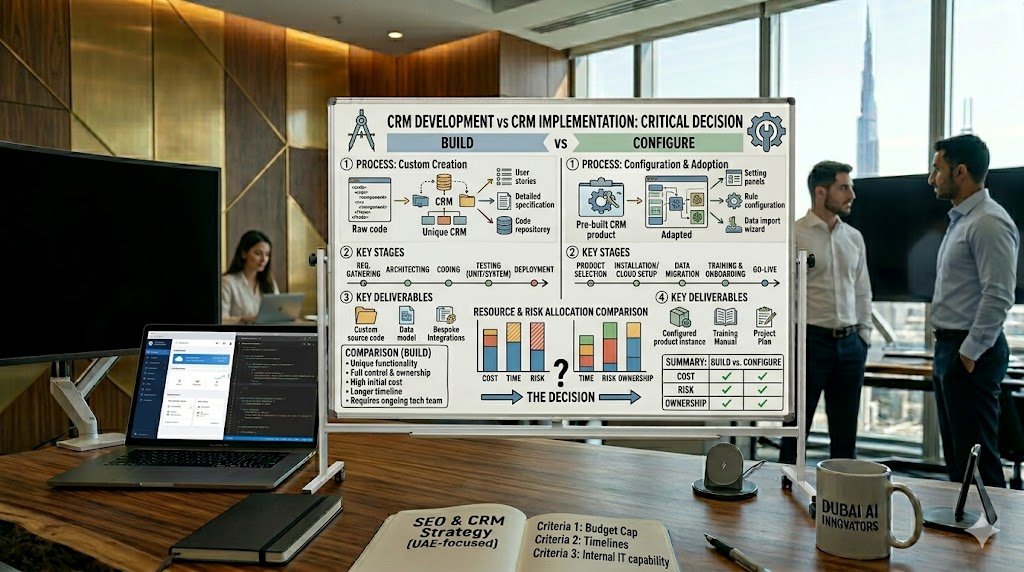
CRM implementation means configuring and deploying an existing, commercially available customer relationship management platform for your specific business needs. The platform itself — HubSpot, Salesforce, Pipedrive, Zoho, or another established product — is already built. Implementation covers selecting the platform, customizing it to reflect your sales process, migrating your existing contact data, setting up integrations with your other tools, building automation workflows, and training your team.
Implementation does not modify the platform’s core code. It works within the platform’s existing capabilities, using its customization options — custom fields, pipeline stages, workflow rules, reporting templates — to make it fit your business as closely as possible. For most Dubai businesses, this level of customization is sufficient to build a highly functional CRM without the cost and complexity of custom development.
What is CRM development?
CRM development means building a CRM application from scratch, or significantly extending an existing platform’s capabilities through custom code. This could mean developing a proprietary CRM using a software framework, building a custom application on top of a platform like Salesforce using its development environment, or creating a highly specialized CRM module that integrates with existing enterprise systems in ways that no off-the-shelf platform supports natively.
Custom CRM development is a software engineering project, not a configuration project. It requires a development team, a defined product specification, quality assurance testing, deployment infrastructure, and ongoing maintenance. The timeline is measured in months rather than weeks, and the cost is significantly higher than implementation of an existing platform. For a deeper look at when this path is justified, see our guide on custom CRM development in Dubai.
Side-by-side comparison
| Factor | CRM implementation | CRM development |
|---|---|---|
| Starting point | Existing commercial platform | Custom-built from code or heavily extended |
| Timeline | 4–10 weeks for most businesses | 3–12 months depending on complexity |
| Cost | Platform fee + implementation service | Full development cost, significantly higher |
| Flexibility | High within platform’s capabilities | Unlimited, constrained only by budget |
| Maintenance | Platform handles core updates | Full maintenance responsibility on client |
| Risk level | Lower — proven platform, defined scope | Higher — scope complexity, development unknowns |
| Best for | Most Dubai SMEs and service businesses | Businesses with highly unique process requirements |
| Scalability | Within platform’s pricing tiers | Custom-built to spec, scalable by design |
When CRM implementation is the right choice for Dubai businesses
For the vast majority of Dubai businesses — service companies, B2B organizations, medical practices, e-commerce businesses, and professional services firms — CRM implementation of an existing platform is the right choice. Modern CRM platforms are highly configurable. HubSpot, Salesforce, Pipedrive, and Zoho all support custom pipeline stages, custom contact and deal fields, complex automation workflows, and integrations with hundreds of tools through native connectors and APIs. Our CRM implementation checklist for Dubai businesses walks through the configuration steps in order.
If the business’s sales process, reporting requirements, and integration needs can be met within the configuration capabilities of an established platform — and for most businesses, they can — there is no business case for the cost and risk of custom development.
When CRM development makes sense
Custom CRM development makes sense in a narrower set of scenarios: when the business has unique process requirements that genuinely cannot be met by any available platform’s configuration options, when the CRM needs to integrate deeply with proprietary internal systems in ways that standard APIs cannot support, when the business has regulatory or data sovereignty requirements that prevent using cloud-based SaaS platforms, or when the CRM functionality is a core product differentiator that the business will commercialize or license to others.
For businesses in Dubai that believe they need custom development, it is worth testing this assumption rigorously. Many requirements that initially seem unique can be met by platform customization. Engaging a CRM consultant to evaluate whether implementation can meet the requirements before committing to development is almost always a worthwhile investment.
Ready to choose the right CRM path for your Dubai business?
DevedUp Business & Marketing helps Dubai businesses evaluate whether CRM implementation or CRM development is the appropriate solution for their specific requirements. The process starts with a review of your sales process, integration requirements, and data needs, followed by a recommendation on which path delivers the most value at the right cost and timeline. If you want a clear answer on which option fits your situation, contact the team for a CRM requirements assessment.
Frequently asked questions
What is the main difference between CRM development and CRM implementation?
CRM implementation configures an existing commercial platform for your business needs. CRM development builds a custom CRM application from code or significantly extends a platform’s capabilities through custom programming. Implementation is faster, lower-cost, and lower-risk. Development is appropriate when genuinely unique requirements cannot be met by any existing platform’s configuration options.
How do I know if my Dubai business needs custom CRM development?
If your requirements can be met within the configuration capabilities of HubSpot, Salesforce, Pipedrive, or Zoho, custom development is not necessary. The test is whether a qualified CRM consultant, after reviewing your process in detail, concludes that no existing platform can meet your needs through configuration alone. Most Dubai businesses that believe they need custom development find that a properly configured implementation of an existing platform is sufficient.
How much does CRM implementation cost in Dubai?
CRM implementation costs in Dubai typically range from AED 5,000–30,000 for a complete implementation including process mapping, platform configuration, data migration, integrations, and team training, depending on complexity and the platform being implemented. Platform subscription fees are additional and range from free (HubSpot basic) to AED 500–3,000 per month for mid-tier plans. Custom CRM development costs significantly more, typically starting from AED 50,000 and increasing with complexity.
How long does CRM development take compared to CRM implementation?
CRM implementation of an existing platform typically takes four to ten weeks for most Dubai businesses, covering process mapping, configuration, data migration, integrations, and training. CRM development of a custom system usually takes three to twelve months depending on scope, because it adds requirement specification, architecture, coding, testing, and deployment. The time gap is one of the main reasons implementation is the default choice for most businesses.
Can a business start with CRM implementation and move to CRM development later?
Yes, and it is often the most sensible path. Implementing an established platform first lets a business run on a working CRM quickly, learn what its process actually needs, and document the real gaps. If genuine limitations emerge that no platform configuration can solve, those documented requirements become the specification for custom CRM development later — a far lower-risk route than building custom from day one.