
Building a marketing dashboard in Dubai sounds straightforward until you are three hours into pulling numbers from four different platforms and still do not have a clear answer to a simple question: which channel generated the most clients last month? The problem is almost never a lack of data. It is the absence of a connected system that turns platform metrics into business intelligence.
This guide covers how to build a marketing dashboard for Dubai businesses that tracks what actually matters, connects the right data sources, and supports real decisions rather than just reporting activity. It connects to analytics and reporting services, BI and performance dashboards, CRM integration, PPC campaign tracking, and SEO performance — because a dashboard that does not connect all these data streams will always leave gaps in the picture.
Step 1: Define the decisions the dashboard needs to support
Before choosing a tool or connecting a single data source, the most important step is defining which decisions the dashboard will inform. A dashboard built around available data will always contain information that nobody acts on. A dashboard built around decisions will contain only what is needed.
For most Dubai businesses, the decisions that need regular data support are: where to allocate next month’s marketing budget, which campaigns to scale or pause, whether the SEO investment is producing organic leads at an acceptable cost, and whether the CRM pipeline reflects enough qualified opportunities to meet revenue targets. Each decision maps to a specific set of metrics, and the dashboard should be built around those metrics rather than the full catalog of available data. Our guide to the marketing KPI dashboard for UAE businesses covers how to choose those metrics.
Step 2: Identify and connect the right data sources
A marketing dashboard for a Dubai business typically needs to pull from several sources simultaneously. The most important are:
- Google Analytics 4: website traffic, user behavior, conversion events, and traffic source attribution
- Google Search Console: organic search impressions, clicks, keyword rankings, and indexation status
- Google Ads: campaign spend, clicks, conversions, cost per lead, and Quality Score data
- CRM platform: pipeline value, lead volume by source, stage conversion rates, deal close rates, and revenue attribution
- Email marketing platform: send volume, open rates, click rates, and revenue or leads attributed to email campaigns
The connection between these sources is what makes the dashboard genuinely useful. Traffic data from GA4 without CRM data tells you how many people visited the site but not how many became clients. Ad spend data without CRM attribution tells you cost per lead but not cost per acquired client. A connected dashboard that links all five sources answers the question that matters most: which marketing investment is generating clients at the most efficient cost? This is the core of a marketing ROI dashboard.
Step 3: Choose the right dashboard tool for your Dubai business
| Tool | Best for | Cost | Key strength |
|---|---|---|---|
| Google Looker Studio | Small to mid-size businesses connecting Google properties | Free | Native Google integrations, no coding required |
| HubSpot Reporting | Businesses using HubSpot CRM | Included in HubSpot plans | CRM and marketing data in one platform |
| Power BI | Mid to large businesses with complex data needs | From $10/user/month | Advanced data modeling, broad connectors |
| Tableau | Larger organizations with dedicated analytics resources | From $75/user/month | Most powerful visualization capability |
| Databox | Agencies and businesses wanting pre-built templates | From $47/month | Fast setup, wide platform integrations |
For most Dubai small to mid-size businesses, Google Looker Studio provides the most practical starting point. It connects natively to Google Ads, GA4, and Search Console, requires no technical expertise to build basic reports, and is free. CRM data can be connected through native integrations (HubSpot, Salesforce) or through Google Sheets as an intermediate layer for platforms without direct connectors.
Step 4: Build the marketing dashboard structure around your funnel
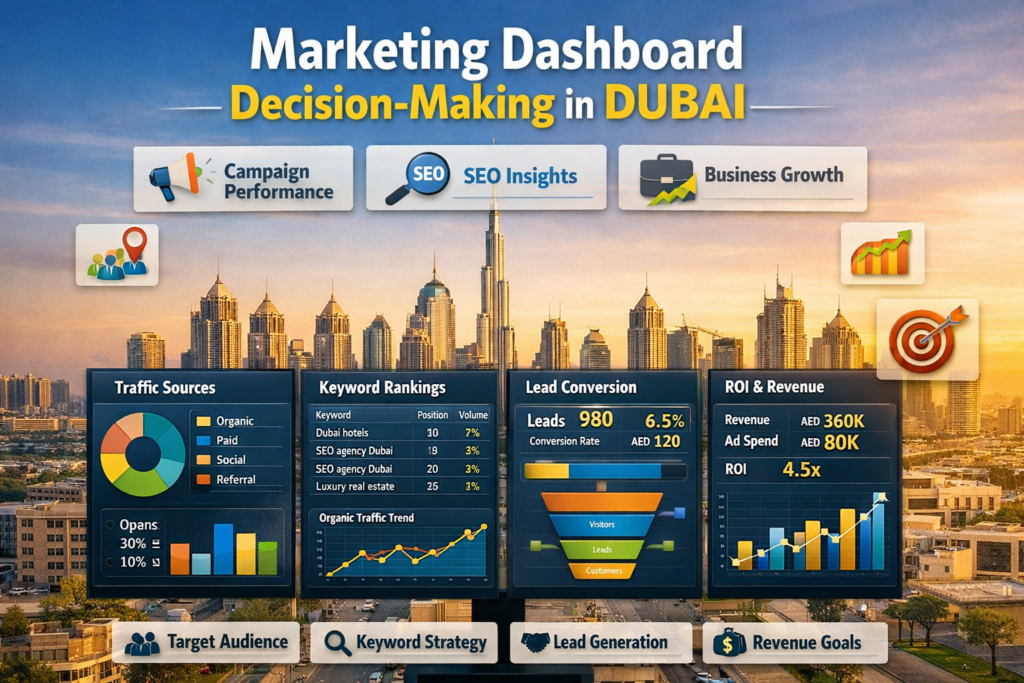
The most effective marketing dashboards for Dubai businesses mirror the customer journey from awareness to revenue. A funnel-based structure makes it immediately visible where volume is entering, where it is being lost, and what the conversion rate looks like at each step.
A practical dashboard structure for a Dubai service business:
- Top of funnel: total website sessions by source, organic impressions, paid impressions and reach
- Mid-funnel: total leads by source, qualified lead percentage, lead-to-meeting conversion rate
- Bottom of funnel: proposals sent, close rate, average deal value, revenue by channel
- Cost efficiency: cost per lead by channel, cost per acquired client by channel, marketing ROI
- Trend view: month-over-month changes across key metrics with context for significant changes
Step 5: Set targets before reviewing the dashboard
A dashboard without targets is a view of what happened. A dashboard with targets is a view of whether performance is on track. Before the dashboard goes live, define the benchmark values for each key metric: what is the expected cost per lead by channel, what is the target conversion rate from lead to qualified conversation, what is the monthly lead volume needed to hit revenue goals?
Target values do not need to be exact from day one. Use industry benchmarks and your own historical data where available, and refine them as the dashboard produces real performance data over the first 90 days. A target that is slightly off is more useful than no target at all, because it gives you a frame of reference for whether a metric value is good, acceptable, or a problem requiring immediate attention.
Step 6: Establish a review cadence and assign ownership
A dashboard that nobody reviews on a defined schedule is a reporting system that produces no decisions. Once the dashboard is live, define who reviews it and how often. A practical cadence for most Dubai businesses is a weekly operational review covering campaign spend pacing and lead volume, and a monthly strategic review covering channel ROI, funnel conversion rates, and budget allocation decisions.
Assign a specific person the responsibility of flagging when key metrics fall outside expected ranges between scheduled reviews. This does not require dedicated analyst time — it requires a defined escalation process when the dashboard shows something that cannot wait until the next scheduled review.
Ready to build a connected marketing dashboard for your Dubai business?
DevedUp Business & Marketing builds marketing dashboards for Dubai businesses that connect Google Ads, organic search, CRM, and analytics into a single decision-support system. Every dashboard is designed around the decisions your team actually makes, not just the data that is technically available. If you want to understand what a connected reporting setup would look like for your business, contact the team for an initial review.
Frequently asked questions
How long does it take to build a marketing dashboard for a Dubai business?
A basic dashboard connecting Google Ads, GA4, and Search Console in Looker Studio can be built in one to two days. A full dashboard including CRM integration, funnel-based structure, and custom KPI targets typically takes one to two weeks depending on data source complexity and the number of platforms involved. The planning phase, defining decisions and metrics, often takes as long as the build itself and directly determines how useful the result is.
Can a marketing dashboard replace a monthly report for a Dubai business?
A dashboard can replace the data-gathering component of a monthly report but not the analysis and recommendations. A dashboard shows what happened. A monthly report explains why it happened and what to do next. Most Dubai businesses benefit from using both: the dashboard for regular monitoring, and a structured report for monthly strategic review that uses dashboard data as its foundation. See marketing analytics dashboard vs regular reports for how the two compare.
What is the most important metric to track in a Dubai marketing dashboard?
For most Dubai service businesses, cost per acquired client by channel is the metric that drives the most valuable decisions. It connects marketing spend to actual revenue outcomes and tells you which channels are producing clients at an efficient cost versus which are generating activity without proportionate return. This metric requires connecting ad spend data to CRM close data, which is why CRM integration is essential for a complete dashboard.
Does a small Dubai business need a marketing dashboard?
Any business running more than one marketing channel simultaneously benefits from a dashboard that shows combined performance. Without it, performance assessment requires manually pulling data from each platform and comparing it in a spreadsheet, which takes time and introduces errors. Even a simple Looker Studio dashboard connecting GA4 and one ad platform provides more visibility than most small Dubai businesses currently have, at no tool cost.
What should a marketing dashboard include for a Dubai business?
A marketing dashboard should be organized around the funnel: top-of-funnel reach (sessions by source, organic and paid impressions), mid-funnel leads (volume by source, qualified-lead rate, lead-to-meeting conversion), bottom-of-funnel revenue (proposals, close rate, revenue by channel), and cost efficiency (cost per lead and cost per acquired client by channel, marketing ROI). Each metric should have a target so the dashboard shows whether performance is on track, not just what happened.