
One of the most common questions Seattle businesses ask before starting paid advertising is: how much is this actually going to cost? The honest answer is that PPC cost in Seattle depends on several factors that vary significantly by industry, competition level, campaign structure, and how well the campaign is managed. Understanding these factors gives you a realistic picture of what to budget and what to expect in return.
This guide breaks down the real cost structure of Google Ads in Seattle, covering ad spend, management fees, cost per click, and cost per lead. It also explains which inputs you can control and which are set by market conditions. If you are trying to decide whether PPC makes sense for your business budget, or whether your current Seattle PPC management costs are reasonable, the breakdown below will give you an informed basis for that decision.
Connecting PPC cost to actual revenue requires data from your CRM and analytics setup — we will cover that too.
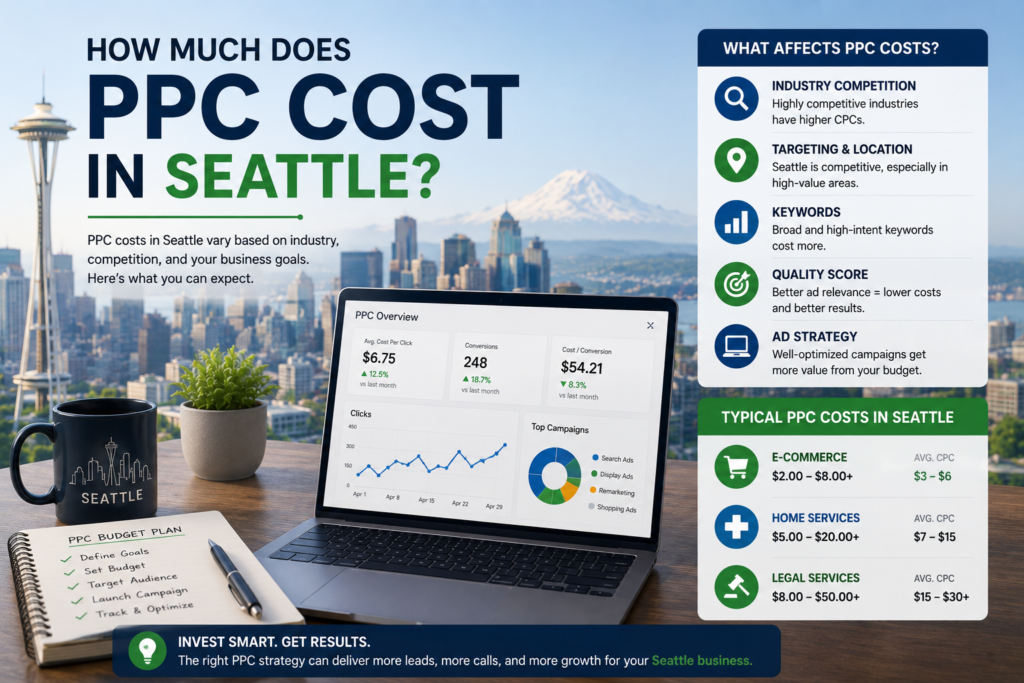
The two components of PPC cost in Seattle
PPC costs have two distinct components that are often conflated: the ad spend (what you pay Google directly for clicks) and the management fee (what you pay the agency or freelancer to run the campaign). Both are real costs. Both should be budgeted for separately. Confusing them leads to either underbudgeting the ad spend or being surprised by management fees that were not discussed upfront.
Ad spend: what you pay Google
Ad spend goes directly to Google and is determined by the cost per click (CPC) for your target keywords multiplied by the number of clicks your campaign generates. CPC in Seattle varies significantly by industry. Here is a realistic range based on typical competitive categories in the Seattle market:
| Industry category | Typical CPC range (Seattle) | Notes |
|---|---|---|
| Legal services | $15–$60+ | Highly competitive, high client value |
| Medical and healthcare | $8–$30 | Competitive, regulated industry |
| Home services (HVAC, plumbing) | $5–$20 | Local competition, seasonal variation |
| B2B professional services | $6–$25 | Longer sales cycle, lower click volume |
| Digital marketing / tech | $4–$15 | Moderate competition in Seattle market |
| E-commerce (general) | $0.50–$5 | Wide range, product-specific |
| Real estate | $3–$12 | Competitive in Seattle metro |
A reasonable starting ad budget for a Seattle service business testing PPC is $1,500–$3,000 per month. Below $1,000 per month, the data accumulates slowly and smart bidding strategies cannot optimize effectively. Above $5,000 per month, campaign management complexity increases and the case for a more experienced agency or team grows stronger.
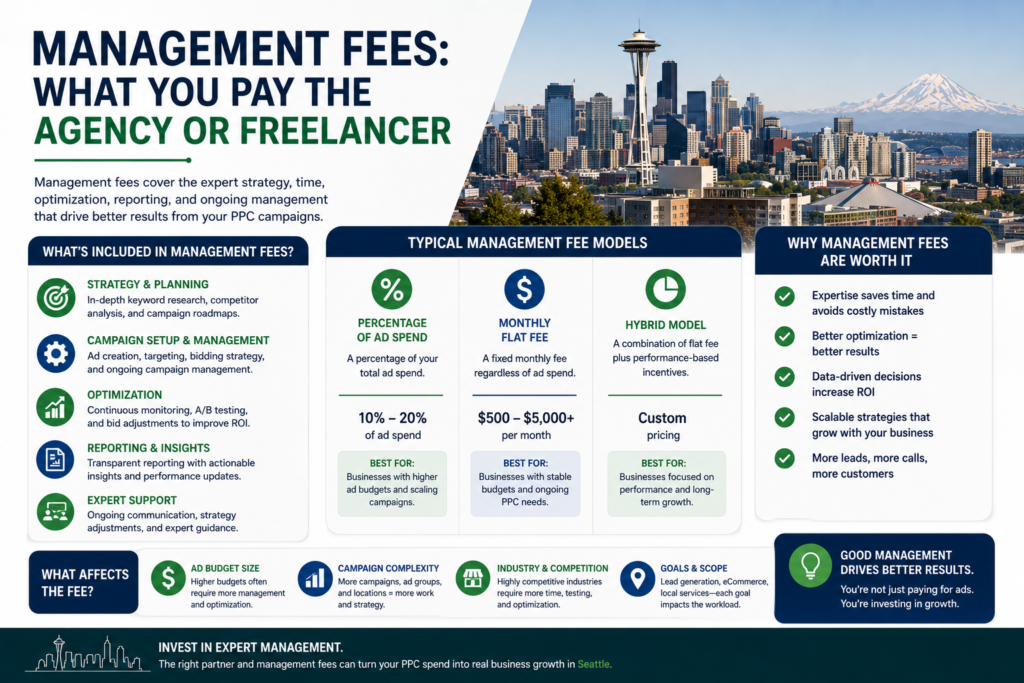
Management fees: what you pay the agency or freelancer
PPC management fees in Seattle typically fall into one of three structures: flat monthly fee, percentage of ad spend, or a hybrid. Each has implications for how the agency’s incentives align with yours. Choosing the right structure is part of how to choose a PPC agency in Seattle.
- Flat monthly fee: most common at lower spend levels, typically $500–2,000 per month for a single-market campaign. The agency’s fee does not increase if you increase your budget, which aligns incentives around performance rather than spend growth.
- Percentage of ad spend: typically 10–20% of monthly ad spend. A $5,000 ad budget at 15% means $750 in management fees. This structure can create an incentive to increase spend rather than improve efficiency, which is worth monitoring.
- Hybrid: a base flat fee plus a smaller percentage of spend above a threshold. Often the most balanced structure for growing campaigns.
What determines cost per lead in Seattle PPC campaigns?
Cost per lead (CPL) is the metric that actually matters for most Seattle service businesses, and it is determined by two factors: cost per click and conversion rate. If your average CPC is $10 and your landing page converts at 5%, your cost per lead is $200. If you improve the conversion rate to 10% without changing the CPC, your cost per lead drops to $100 — the same budget now generates twice the leads.
This is why landing page quality and ad message alignment are not optional additions to PPC management. They are the primary levers for improving cost efficiency beyond what keyword bidding alone can achieve. This is especially true for local service PPC in Seattle, where intent is high and the landing page must confirm relevance fast.
Realistic CPL benchmarks for Seattle service businesses vary widely:
- Legal: $150–400+ per lead
- Healthcare / medical clinics: $80–200 per lead
- Home services: $40–120 per lead
- B2B professional services: $100–300 per lead
- Digital marketing / tech services: $60–180 per lead
These are starting benchmarks. Well-managed campaigns with strong landing pages and tight targeting consistently outperform these ranges. Poorly managed campaigns with broad match keywords and weak pages can spend two to three times more per lead than necessary.
How do you calculate whether PPC is worth the cost for your Seattle business?
The calculation requires knowing your average client value and your lead-to-client close rate. If your average client generates $5,000 in revenue and your close rate is 20%, you can afford up to $1,000 per lead and still have a positive return. If your average client value is $500 and your close rate is 10%, a $150 cost per lead produces a break-even campaign at best.
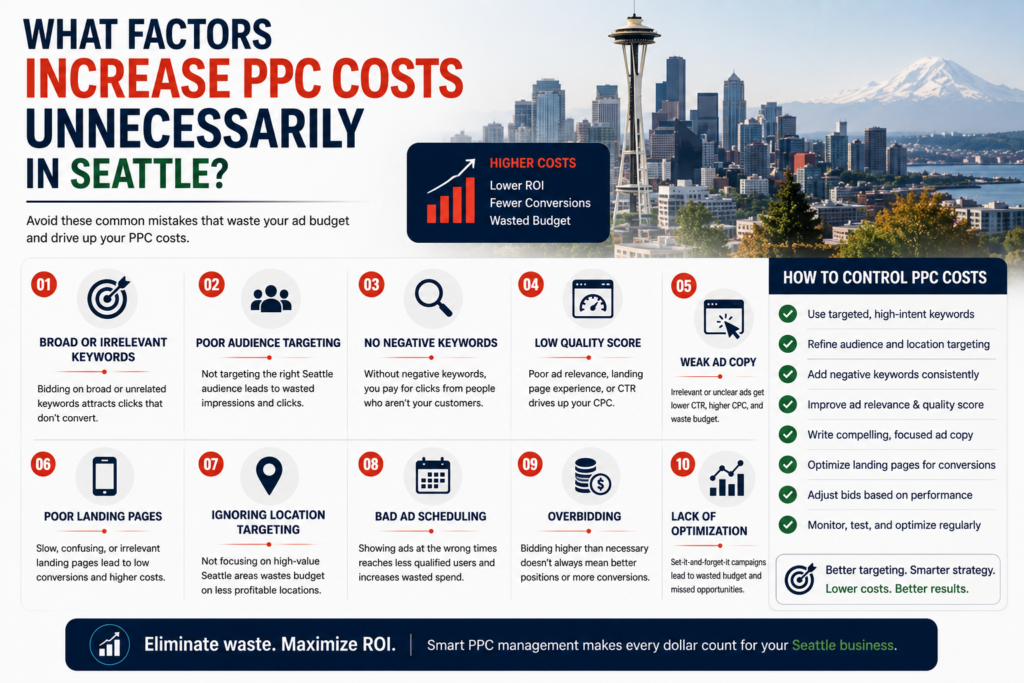
What factors increase PPC costs unnecessarily in Seattle?
Several campaign management failures consistently inflate PPC costs without improving lead quality:
- Broad match keywords without well-maintained negative lists, attracting irrelevant traffic at full CPC rates
- Geographic targeting set to “Presence or interest” rather than “Presence only,” showing ads to users outside Seattle
- Sending all traffic to a homepage or general service page rather than a conversion-focused landing page
- Running campaigns 24/7 when conversions primarily happen during business hours
- Smart bidding strategies activated before enough conversion data has accumulated to optimize effectively
Each of these is a structural issue that management fees should be addressing, not perpetuating. Good Google Ads management in Seattle fixes these rather than billing around them.
What total PPC budget should a Seattle business plan for?
A realistic all-in budget for a Seattle service business new to PPC typically ranges from $2,000–$5,000 per month total: $1,500–$3,500 in ad spend plus $500–$1,500 in management fees. This provides enough data to optimize meaningfully within the first 60–90 days and enough volume to make smart bidding strategies viable.
Businesses with higher average client values can justify higher initial budgets because the per-lead cost threshold for profitability is higher. Businesses with lower transaction values need tighter targeting and stronger conversion rates to make PPC work within a smaller budget.
Ready to plan your Seattle PPC budget?
Understanding PPC cost in Seattle is the starting point for a realistic campaign plan. The numbers in this guide are benchmarks, not guarantees — actual performance depends on campaign structure, landing page quality, and the competitiveness of your specific keywords.
DevedUp Business & Marketing builds and manages Google Ads campaigns in Seattle with full transparency on where budget is being spent and what it is generating. If you want a realistic cost estimate for your specific business and target keywords before committing to a budget, contact the team for an initial assessment.
Frequently asked questions
What is the minimum PPC budget for a Seattle business?
There is no absolute minimum, but campaigns with less than $1,000 per month in ad spend accumulate data slowly and cannot use smart bidding strategies effectively. For most Seattle service businesses, $1,500–$2,000 per month in ad spend is a practical starting point for generating enough data to optimize within 60–90 days.
Why is cost per click higher in Seattle than in other markets?
CPC in Seattle reflects the competitive intensity of the local market and the value of clients in specific industries. Legal, medical, and B2B service categories have high CPCs because the client lifetime value justifies significant acquisition costs. Markets with more advertisers bidding on the same keywords drive CPCs higher through Google’s auction mechanism, regardless of location.
How do I reduce cost per lead in a Seattle PPC campaign?
The two most effective levers are improving landing page conversion rate and tightening keyword targeting to reduce irrelevant clicks. A 1% improvement in conversion rate reduces cost per lead by roughly 20% on a campaign converting at 5%. Maintaining a strong negative keyword list prevents budget from being spent on searches that will not convert, which reduces cost per lead without touching bids or budgets.
Is PPC cost-effective for small Seattle businesses?
It depends on client value and close rate. PPC is most cost-effective for businesses with high average client values, because the acceptable cost per lead threshold is higher. For businesses with lower transaction values, tight targeting, strong landing pages, and efficient management are essential to keep cost per lead within a profitable range. A realistic pre-launch calculation using your actual client value and estimated close rate will tell you what cost per lead the campaign needs to achieve to be worthwhile.
How much does PPC cost in Seattle per month?
A typical all-in monthly cost for a Seattle service business new to PPC is $2,000–5,000: roughly $1,500–3,500 in ad spend paid to Google plus $500–1,500 in management fees. The exact figure depends on the industry (legal and medical run higher), the competitiveness of your keywords, and how large a service area you target. The number worth watching is cost per qualified lead, not total spend, since a well-managed smaller budget often beats a poorly managed larger one.