
Seattle businesses often reach a point where marketing complexity grows faster than internal clarity. More channels need attention. SEO starts requiring technical work and content planning. Paid campaigns need tighter tracking. Websites need updates. CRM workflows become more important. Reporting expectations increase. At that point, leadership starts asking a practical question: should we build an internal team or work with an external agency? That question is the heart of the in-house marketing vs agency decision.
The debate around in-house marketing vs agency is not really about which model sounds more modern or more committed. It is about operating structure. It is about how a business wants to access strategy, execution, speed, specialization, and accountability while staying aligned with revenue goals.
For some companies, an internal team creates stronger day-to-day coordination and deeper brand immersion. For others, working with a digital marketing agency Seattle businesses trust can provide broader expertise, faster execution, and a more efficient path to growth without the cost of building a full department internally.
In Seattle, this decision matters even more because many businesses operate in competitive markets where digital performance is tied directly to visibility, trust, and lead generation. Healthcare providers, professional service firms, B2B companies, home service brands, real estate groups, and local service businesses often need multiple capabilities at once. They do not just need social media or ads. They need a connected system that supports search, conversion, reporting, and brand credibility.
This article explains the difference between in-house marketing and agency support, what Seattle businesses should consider before choosing, and when a hybrid model may be the strongest answer.

Why is this decision so important for Seattle businesses?
Seattle is a market where digital marketing maturity is high and competition is often strong. Customers compare providers carefully. They search locally. They review websites. They evaluate trust quickly. They respond to performance, clarity, and credibility.
That means marketing is rarely just one function.
A business may need:
- local SEO
- Google Ads
- landing page optimization
- content planning
- reporting
- CRM coordination
- email workflows
- website improvements
- brand messaging alignment
When these needs grow, leadership has to decide how that work should be structured.
The choice between an internal team and a marketing agency Seattle partner affects:
- how quickly campaigns launch
- how specialized the expertise is
- how much the business spends on payroll and tools
- how strategy and execution stay aligned
- how easy it is to scale across multiple channels
- how accountable the work becomes
This is why in-house marketing vs agency is not only a hiring question. It is a business systems question.
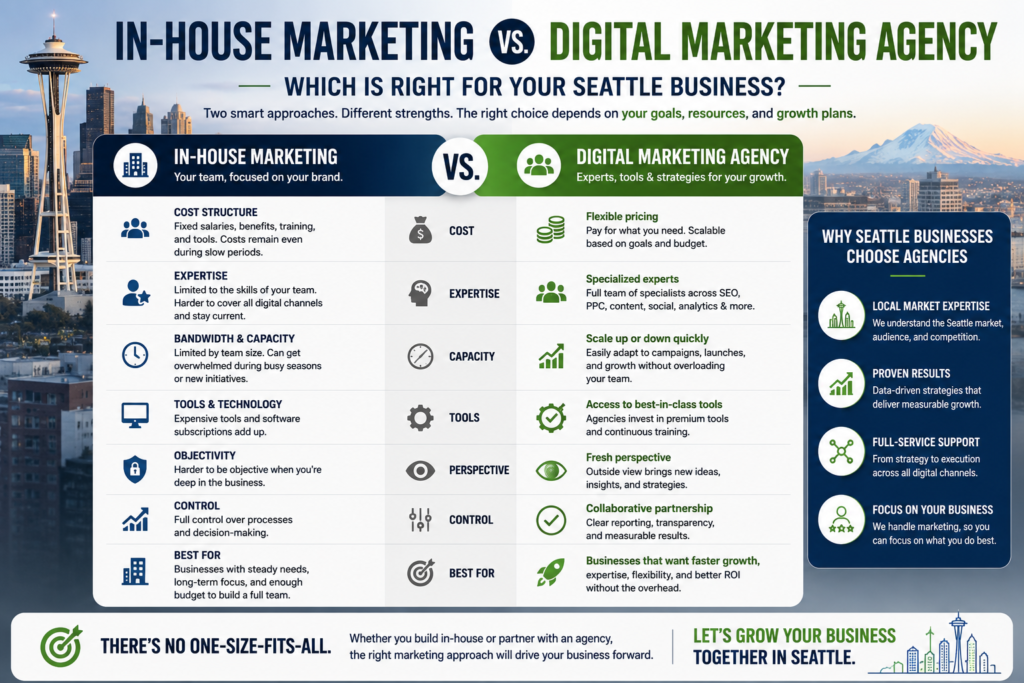
What does in-house marketing mean?
In-house marketing means the business hires its own employees to manage some or all marketing functions internally.
That may include:
- a marketing manager
- content writers
- paid media specialists
- SEO staff
- designers
- CRM or automation support
- social media managers
- marketing coordinators
In some companies, “in-house marketing” means one generalist handling everything. In others, it means a full department with multiple specialists.
The main advantage is proximity. Internal teams are closer to:
- leadership decisions
- sales conversations
- service delivery reality
- product changes
- brand tone
- day-to-day priorities
That closeness can improve speed of internal communication and brand familiarity. Still, it does not automatically guarantee better marketing performance. The outcome depends on whether the internal team has the right mix of skills, systems, support, and leadership alignment.
What does working with a digital marketing agency mean?
Working with a digital marketing agency Seattle usually means the business partners with an external team that provides some combination of strategy, implementation, optimization, and reporting.
That may include:
- SEO
- PPC
- content strategy
- website development
- design
- analytics
- CRM support
- email marketing
- automation
- broader digital consulting
The agency model gives businesses access to a wider range of skills without hiring each role internally. Our guide on what a digital marketing agency in Seattle actually does breaks down that scope in detail.
For example, a company may need:
- an SEO strategist
- a Google Ads specialist
- a web developer
- a conversion-focused copywriter
- a designer
- a reporting specialist
Hiring all of those internally is often expensive and difficult. A marketing agency Seattle partner can provide access to that range of expertise more quickly.
The question is not whether agencies are better by default. The question is whether the agency structure fits the business’s current growth needs more effectively than internal hiring.
What are the main advantages of in-house marketing?
In-house marketing can be a strong model in the right context.
1. Stronger brand immersion
Internal marketers usually understand the business deeply over time. They hear customer language, join internal meetings, and absorb product or service nuances more directly.
2. Faster day-to-day coordination
When marketing sits inside the organization, communication with leadership, sales, operations, and customer-facing teams can happen more easily.
3. Better alignment with internal priorities
Internal teams often shift faster when priorities change suddenly. They are already close to the business.
4. Long-term institutional knowledge
As the team grows, the company builds internal knowledge about audience behavior, messaging, campaign history, and brand evolution.
5. Greater control over workflow
Leadership may feel more direct oversight over priorities, timelines, and execution when the team is internal.
These advantages matter especially for larger companies or businesses with enough volume and complexity to justify a more developed internal department.
What are the main limitations of in-house marketing?
This is where many businesses underestimate the challenge.
1. High hiring and payroll costs
Building a strong internal marketing team usually requires more than one person. Even if one hire is strong, one person rarely covers SEO, PPC, content, analytics, design, strategy, and website performance at a high level all at once.
2. Skill gaps
A small internal team often becomes too generalist. That can leave important areas underdeveloped, especially technical SEO, advanced paid media optimization, CRM workflows, analytics, or web performance.
3. Slower scaling of expertise
If the business suddenly needs a new capability, it must recruit, onboard, and train. That takes time.
4. Tool and systems overhead
Internal teams often require paid tools, software, reporting systems, and training resources that add to the real cost of the department.
5. Management dependency
Internal teams need leadership, prioritization, and process. Without clear direction, even talented people can become reactive and overstretched.
This is one reason many Seattle companies discover that “building in-house” is not necessarily simpler. It often shifts complexity inward rather than reducing it.
What are the main advantages of a digital marketing agency in Seattle?
A strong digital marketing agency Seattle businesses work with can offer several major advantages.
1. Broader expertise from day one
Agencies usually bring multi-disciplinary experience across channels, industries, and systems. That means businesses can access specialists without hiring each one individually.
2. Faster execution across channels
Because agencies often already have processes, tools, and workflows in place, they can move faster on SEO, PPC, content, development, reporting, and optimization.
3. More efficient access to specialization
A Seattle company may not need a full-time technical SEO specialist or CRM strategist internally, but it may still need that expertise regularly. An agency provides access without the full payroll burden. If search is the priority, see how to find the right SEO company in Seattle.
4. External perspective
Agencies can often identify blind spots that internal teams miss. They are less likely to be locked into internal assumptions.
5. Scalability
As needs expand, a marketing agency Seattle can often add services or specialized support faster than an internal hiring process can.
6. Structured accountability
A strong agency relationship usually includes reporting, deliverables, milestones, and performance reviews that help keep work measurable.
For many businesses, these advantages are why agency support becomes attractive once digital growth depends on multiple connected functions.
What are the main limitations of working with an agency?
Agency support also has trade-offs.
1. Less immediate internal proximity
An external team is not inside every meeting or operational conversation. That means communication structure matters more.
2. Variable quality across providers
Not every agency is strategic. Some are reactive vendors. Others are overly tactical and fail to connect execution to business goals.
3. Requires onboarding and alignment
A good agency still needs time and clarity to understand the business properly. Without strong onboarding, the work may stay superficial.
4. Risk of channel silos
Some agencies are strong in one area and weak in others. A business may get great ads but weak content, or strong design but poor SEO structure.
5. Communication quality matters
The wrong agency relationship can feel slow, vague, or disconnected from what leadership actually needs.
This is why choosing the right digital marketing agency Seattle partner is as important as deciding to use an agency at all.
Which model is more cost-effective?
The answer depends on what capabilities the business actually needs.
In-house often looks cheaper at first when:
- the business hires one person
- the work appears limited
- leadership assumes one role can cover multiple functions
But the true cost usually includes:
- salary
- benefits
- software
- training
- management time
- recruitment cost
- gaps in specialization
- slower execution when one person becomes overloaded
An agency often looks more expensive at first when:
- comparing only monthly retainer cost
- ignoring the cost of building equivalent expertise internally rather than outsourcing it
But the value often includes:
- multiple specialists
- tools and systems
- implementation capacity
- broader strategic input
- faster deployment
- less internal hiring burden
So the better question is not “Which is cheaper?” It is “Which structure gives us the capabilities we actually need for the cost we can support?”
For many Seattle businesses, a digital marketing agency Seattle becomes more cost-efficient when the business needs several skills at once but is not ready to build a full internal department.
Which model is better for fast growth?
Agencies often have the advantage when speed matters.
That is because fast growth usually requires:
- multi-channel coordination
- faster testing
- stronger reporting
- landing page improvements
- SEO and PPC alignment
- broader technical support
- rapid campaign adjustments
An internal team can absolutely support growth, but it usually needs enough staffing depth to avoid bottlenecks.
A business with one or two internal marketers may struggle to scale quickly across:
- SEO
- paid search
- content
- development
- conversion optimization
- analytics
A digital marketing agency Seattle can often move faster because the resources already exist.
That said, if the company already has a strong internal leader and mature systems, in-house can perform well too. The real issue is readiness, not ideology.
Which model is better for long-term brand alignment?
In-house often has the advantage in brand immersion, but agencies can close the gap if the relationship is strong.
Internal teams are usually better positioned to:
- understand internal culture
- stay close to product or service changes
- absorb customer language continuously
- move with leadership in real time
Still, a strong marketing agency Seattle can become highly aligned when:
- onboarding is done properly
- the relationship is long-term
- communication is structured
- the agency has access to decision-makers
- reporting and strategy discussions are regular
The biggest mistake is assuming brand alignment happens automatically in-house and cannot happen externally. Both models need process and clarity.
When is in-house marketing the better choice?
In-house is often the stronger choice when:
- the company is large enough to support a full team
- the brand changes quickly and needs constant coordination
- marketing must stay embedded in daily cross-functional work
- there is enough budget for multiple specialist hires
- leadership wants to build internal long-term capability deliberately
- the company already has strong marketing management
This model often fits:
- larger SaaS companies
- mature B2B organizations
- businesses with constant product or service updates
- teams that need daily collaboration between departments
The key is that in-house works best when it is properly staffed and properly led.
When is an agency the better choice?
An agency is often the stronger choice when:
- the business needs multiple skill sets quickly
- internal hiring would be too slow or too expensive
- SEO, PPC, development, and content all matter at once
- leadership wants expert support without building a full department
- the company needs strategic direction as well as execution
- growth depends on better digital performance in the near term
This often fits:
- small to mid-sized businesses
- healthcare and local service brands
- professional service firms
- home service businesses
- real estate and property-related companies
- growing B2B firms without a mature internal team
In these situations, a digital marketing agency Seattle can provide a stronger operating structure than a thin internal setup. The next step is knowing how to choose a digital marketing agency in Seattle.
Is a hybrid model the best option?
In many cases, yes.
A hybrid model often gives businesses the best balance between internal alignment and external expertise.
For example:
- an internal marketing manager handles coordination and brand direction
- the agency supports SEO, PPC, development, content, or analytics
- internal leadership stays close to priorities
- external specialists handle deeper execution
This can work especially well when:
- the company wants internal ownership but not full internal staffing
- the internal team is strong strategically but limited technically
- the business wants flexibility across multiple marketing functions
- leadership wants both speed and brand alignment
For many companies, the real answer to in-house marketing vs agency is not one or the other. It is choosing the right split of responsibilities.
What should businesses ask before deciding?
A useful decision starts with honest questions.
1. What capabilities do we actually need?
Do you need one generalist, or do you really need SEO, PPC, website, analytics, content, and CRM support?
2. How quickly do we need results?
If speed matters, internal hiring may be too slow.
3. Do we have strong internal marketing leadership?
Without good direction, even internal teams struggle.
4. Is our marketing challenge strategic, tactical, or both?
Some businesses need execution help. Others need clearer direction first.
5. Can one internal hire realistically cover what we need?
Often the answer is no.
6. How important is channel integration?
If SEO, PPC, website performance, CRM, and content all need to work together, specialization matters more.
These questions usually lead to a more realistic decision than simply comparing salary versus retainer.
What should Seattle businesses look for in an agency?
If the business leans toward agency support, the next step is choosing well.
Look for a digital marketing agency Seattle partner that can demonstrate:
- strategic thinking, not just task execution
- channel integration across SEO, PPC, web, and reporting
- clear communication and accountability
- strong onboarding process
- practical understanding of local and US market dynamics
- ability to connect marketing work to business outcomes
- transparency around scope, process, and priorities
A strong agency should not feel like a vendor waiting for tasks. It should feel like a growth partner with structure and perspective.
How does DevedUp Seattle approach this decision?
DevedUp Business & Marketing approaches the question of in-house marketing vs agency as a business structure decision rather than a fixed ideology.
For some companies, the strongest path is full external support. For others, it is a hybrid model where internal leadership works alongside agency specialists. The recommendation depends on:
- business size
- channel complexity
- speed requirements
- internal capacity
- growth goals
- current digital maturity
Because DevedUp works across SEO, PPC, content, web development, CRM, and performance strategy, the focus is usually on building a system that fits the business rather than pushing one staffing model universally.
That matters because the right answer is not “always hire in-house” or “always outsource.” The right answer is choosing the structure that supports better performance with less friction.
In-house marketing vs agency: so which one is better?
There is no universal winner.
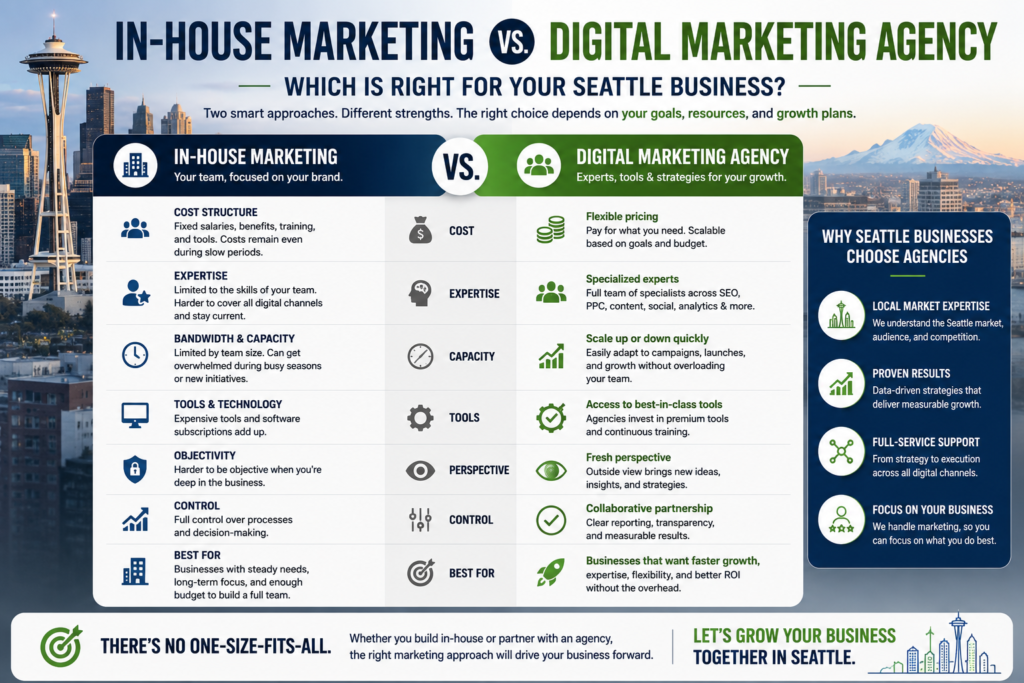
In-house marketing is better when the business has enough scale, budget, and internal leadership to support a real team well. A digital marketing agency Seattle is better when the business needs broad expertise, faster execution, and more efficient access to specialized capabilities without building a full internal department.
For many Seattle businesses, the most practical answer is:
- choose in-house if you can build and manage real depth
- choose agency if you need multi-channel expertise and speed
- choose hybrid if you want internal ownership with external specialization
That is usually the most honest framework.
Conclusion
The debate around in-house marketing vs agency is not about which model sounds better in theory. It is about which one gives your Seattle business the right structure for growth. In-house teams offer closeness, brand immersion, and direct coordination. A strong digital marketing agency Seattle can offer broader expertise, faster execution, and a more efficient path to channel specialization.
For many businesses, especially those needing SEO, PPC, content, website support, and reporting at the same time, working with a marketing agency Seattle partner can be the more practical route. For others, internal marketing becomes the stronger long-term model once enough scale and leadership are in place. In many cases, the best answer is a hybrid structure that combines internal direction with external execution.
Businesses evaluating Seattle marketing services should focus on capability, accountability, speed, and business alignment rather than assumptions about staffing models alone. A partner that approaches this as part of a broader digital growth system adds more value than one that simply fills tasks.
Frequently asked questions
Is it cheaper to hire in-house or use a marketing agency?
It depends on how many capabilities you need. One in-house generalist can look cheaper than a retainer, but the true cost includes salary, benefits, tools, training, and management time — and one person rarely covers SEO, PPC, content, analytics, and web performance well. An agency is often more cost-efficient when you need several skills at once but are not ready to staff a full department.
When should a Seattle business choose an agency over in-house?
Lean toward an agency when you need multiple skill sets quickly, internal hiring would be too slow or expensive, several channels matter at once, or you want strategic direction plus execution without building a full team. This often fits small to mid-sized firms, healthcare and local service brands, and growing B2B companies.
What is a hybrid marketing model?
A hybrid model pairs internal ownership with external specialization — for example, an in-house manager handles coordination and brand direction while an agency supports SEO, PPC, development, content, or analytics. It works well when a team is strong strategically but limited technically, or wants both speed and brand alignment.
Does in-house marketing give better brand alignment?
In-house teams usually have an edge in brand immersion because they sit close to leadership, sales, and product changes. But a strong agency can close that gap with proper onboarding, a long-term relationship, structured communication, and access to decision-makers. Brand alignment is not automatic in either model — both need process.
How do I choose the right digital marketing agency in Seattle?
Look for strategic thinking rather than task execution, genuine channel integration across SEO, PPC, web, and reporting, clear communication and accountability, a strong onboarding process, and the ability to connect marketing work to business outcomes. The right partner feels like a growth partner with structure, not a vendor waiting for instructions.
Is it time to choose the right marketing structure for your Seattle business?
If your company is weighing in-house marketing vs agency, the next step is to evaluate what capabilities you need now, how quickly you need them, and whether your business is ready to build that depth internally. For companies that need a broader mix of Seattle marketing services across SEO, PPC, website performance, content, and strategy, working with a digital marketing agency Seattle can often create faster and more flexible results than building a full internal department too early. For structured support, contact DevedUp to map the right growth structure for your business.