
Seattle businesses are operating in a market where speed, accuracy, and operational efficiency matter as much as marketing visibility. Many companies have already improved how they attract leads, manage campaigns, and build digital presence. The next challenge is different. It is about handling growth without increasing internal complexity at the same pace.
That is where workflow automation Seattle becomes more than a trend. It becomes an operational advantage.
When teams depend on repetitive manual work, disconnected systems, and slow internal handoffs, growth creates friction. Sales teams spend too much time on admin. Marketing teams repeat reporting tasks. Operations teams manage workflows through email threads and spreadsheets. Customer support teams answer the same questions again and again. Over time, these inefficiencies reduce margins, delay response times, and make scaling harder.
A structured approach to business automation Seattle helps companies solve these problems by turning repeated tasks into measurable systems. That can include lead routing, reporting workflows, customer communication, internal task automation, CRM actions, document handling, and cross-platform processes that no longer need constant manual intervention.
This article explains how workflow automation Seattle supports business growth, where AI creates practical value, what kinds of Seattle companies benefit most, and how a strategic partner can help connect automation to real operational outcomes.
Why are Seattle businesses investing more in AI automation?
The short answer is operational pressure.
Seattle is home to companies in technology, healthcare, professional services, real estate, e-commerce, consulting, home services, and B2B sectors that often rely on fast response times and lean execution. As those businesses grow, operational complexity grows with them. More leads, more customer touchpoints, more internal communication, and more systems usually mean more manual work unless the business is designed to scale intelligently.
This is why workflow automation Seattle is becoming a practical priority. Businesses are not simply adopting AI because it sounds innovative. They are adopting it because they want to remove friction from day-to-day work.
Key reasons include:
- reducing time spent on repetitive administrative tasks
- improving response speed across departments
- standardizing processes across teams
- supporting growth without proportional headcount expansion
- improving accuracy in data handling and reporting
- creating more visibility into how work moves through the business
For many companies, the goal is not replacing people. The goal is helping people spend less time on low-value repetition and more time on decisions, client relationships, and higher-impact work.
What does AI automation actually mean in a business context?
This question matters because many businesses hear about AI in broad terms but struggle to connect it to operations. For a fuller definition, see our guide to what AI automation is and how Seattle companies use it.
In practice, AI services Seattle businesses use are often focused on structured tasks, decision support, and workflow improvement. That includes combining AI with automation logic, CRM systems, data flows, forms, internal tools, communication platforms, and reporting systems.
AI automation may involve:
- automatically routing incoming leads based on intent or service type
- summarizing calls, meetings, or customer conversations
- generating follow-up drafts for sales or support teams
- classifying inquiries before they reach the right department
- extracting data from forms, documents, or emails
- automating recurring reports and internal notifications
- triggering workflows based on customer behavior or internal events
- helping teams search and organize operational knowledge faster
The important distinction is this: AI becomes useful when it is tied to a real process.
A business does not scale because it added AI somewhere in the organization. It scales when AI reduces manual effort, improves consistency, and supports faster execution in systems that matter.
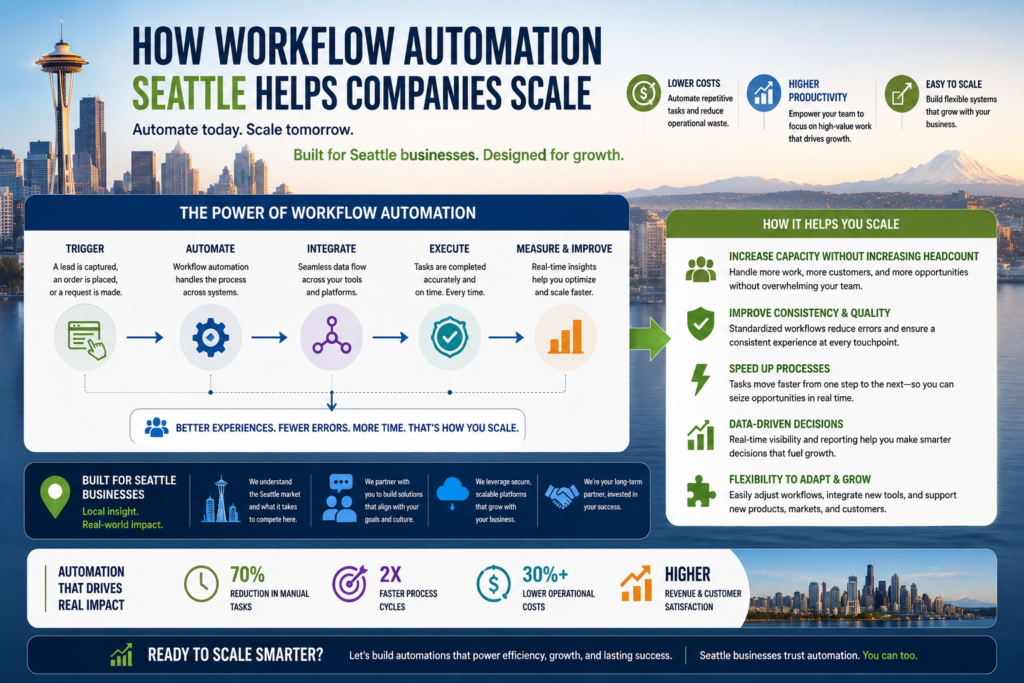
How workflow automation Seattle helps companies scale
Scaling operations without automation usually creates one of two outcomes. Either the business slows down, or the payroll expands faster than productivity.
That is why business automation Seattle has become so important for growth-focused companies. It allows businesses to increase capacity without increasing friction at the same rate.
Here is how automation supports scale.
It reduces repetitive work
Many teams repeat the same actions every day:
- moving data from one tool to another
- sending the same types of follow-up emails
- assigning tasks manually
- building recurring reports
- answering routine internal questions
- updating CRM records
- checking status across platforms
These activities consume time but do not always require human judgment. Once automated properly, they free up significant operational capacity.
It improves consistency
Manual processes vary by person. Automated workflows follow defined logic. That helps businesses maintain more consistent lead handling, support responses, reporting standards, and internal coordination.
It supports speed
Automation reduces lag between actions. A lead can be assigned instantly. A support ticket can be categorized automatically. A manager can receive a performance alert without waiting for someone to notice an issue manually.
It makes scaling more measurable
When processes are automated, businesses can measure them more clearly. They can see where delays happen, how work moves, and where operational bottlenecks still remain.
This is why workflow automation Seattle is not just about saving time. It is about creating a structure that can absorb growth more effectively.
What types of workflows are best suited for automation?
Not every process should be automated. The best automation targets repeated tasks with clear logic, measurable inputs, and predictable outputs.
In many Seattle companies, strong automation opportunities include:
Lead management workflows
- routing inquiries by service, location, or urgency
- tagging leads by source
- creating follow-up tasks automatically
- syncing website forms into CRM
- sending confirmation and scheduling communications
Sales support workflows
- generating summary notes after calls
- creating reminders for stalled opportunities
- updating pipeline stages based on activity
- drafting repetitive outreach or follow-up messages
- notifying managers when high-value leads enter the pipeline
Marketing workflows
- compiling campaign reports
- categorizing inbound content requests
- automating lead nurturing sequences
- routing qualified leads to sales
- summarizing performance across channels
Operations workflows
- moving information between internal systems
- automating status updates
- assigning tasks between departments
- monitoring approval processes
- triggering internal alerts when steps are delayed
Customer service workflows
- classifying support requests
- suggesting response drafts
- routing tickets by issue type
- pulling customer context into one view
- automating standard service communications
The most effective AI agency Seattle teams usually start with these kinds of workflows because the operational value is easier to prove.
What makes AI different from standard workflow automation?
Traditional automation follows rule-based logic. If X happens, do Y. That is useful for many business tasks.
AI adds a layer of interpretation, summarization, classification, prediction, or content generation that standard automation cannot handle alone.
For example:
Standard automation
If a form is submitted, send the lead to the CRM and assign it to the sales team.
AI-enhanced automation
If a form is submitted, classify the inquiry by intent, summarize the request, score urgency based on wording, route it to the right department, and generate an internal summary for the assigned rep.
This is why AI automation Seattle can go beyond task repetition. It can help businesses handle more complex information flows while still reducing manual work.
Still, AI is not a replacement for process design. Businesses need clear workflows first. AI works best when layered on top of structured systems, not when used to compensate for operational confusion.
How can AI automation improve sales operations?
Sales teams often carry a heavy burden of small operational tasks that reduce actual selling time. They update records, summarize conversations, chase internal approvals, organize lead notes, and manage reminders across different tools.
A strong workflow automation Seattle setup can improve sales operations by reducing these low-value tasks.
Examples include:
- automatic lead assignment from forms or campaigns
- AI-generated summaries of discovery calls
- follow-up task creation after meetings
- proposal reminders based on opportunity age
- deal-stage updates triggered by activity
- CRM note organization and tagging
- internal alerts when priority leads are inactive too long
This improves sales performance in two ways.
First, it increases speed. Leads are handled faster and more consistently.
Second, it improves focus. Sales reps spend more time on conversations, qualification, and closing rather than administrative cleanup.
For Seattle businesses in consulting, healthcare, professional services, real estate, and B2B, this can directly affect revenue efficiency.
Can AI automation help marketing teams too?
Yes, and often more than expected.
Marketing teams are usually asked to do more without getting more time. They run campaigns, monitor performance, build reports, manage content production, coordinate with sales, and respond to internal requests. This is one reason AI services Seattle are gaining attention among growth teams.
AI automation can support marketing by helping with:
Reporting workflows
Recurring campaign performance summaries can be compiled and formatted faster.
Lead qualification support
Marketing can tag or segment leads based on behavior, source quality, or form content.
Internal request handling
Creative, content, or web tasks can be categorized and routed automatically.
Content operations
AI can help summarize briefs, organize research notes, and support first-draft workflow for internal use.
Handoff to sales
Automation can notify sales when a lead reaches qualification thresholds or completes certain actions.
This does not eliminate the need for strategic marketers. It helps them spend less time on mechanical workflow work and more time on campaign quality, decision-making, and performance improvement. It often pairs well with CRM and marketing automation working together.
What operational bottlenecks does AI automation solve first?
Businesses usually see the strongest early gains when they target obvious friction points rather than trying to automate everything at once.
The most common early automation wins include:
Slow response times
Leads or inquiries sit too long before anyone responds.
Repetitive admin work
Teams copy the same information between systems every day.
Poor internal visibility
Managers cannot quickly see what has moved, stalled, or needs attention.
Inconsistent task routing
Requests go to the wrong person or require manual handoff every time.
Fragmented data
Customer or operational information lives across multiple tools without structure.
Reporting delays
Teams build the same reports repeatedly with manual effort.
For many Seattle businesses, these issues exist long before leadership recognizes them as automation problems. They often show up as team fatigue, missed opportunities, and slower-than-expected growth.
What are the signs your business is ready for AI automation?
A company does not need to be large to benefit from automation. It needs repeated operational patterns and enough volume for inefficiency to become noticeable.
Strong signs include:
- the team handles similar tasks every day
- response speed is becoming harder to maintain
- work depends too much on memory or manual coordination
- information must move across multiple platforms
- reporting takes too much time each week or month
- customer or lead handling is inconsistent
- growth is increasing operational complexity faster than expected
- managers lack visibility into where work is getting stuck
If these issues are present, workflow automation Seattle may create immediate practical value.
The key is starting with a specific workflow problem, not with the broad goal of “using AI.”
What industries in Seattle benefit most from AI automation?
Many industries can benefit, but the strongest value usually appears where process repetition, high communication volume, or multi-step workflows already exist.
Professional services
Agencies, consultants, law firms, and accounting firms often benefit from lead triage, proposal support workflows, reporting automation, and CRM coordination.
Healthcare and clinics
Patient inquiries, intake routing, appointment communication, internal documentation, and follow-up workflows can often be improved.
B2B companies
Longer pipelines and multiple stakeholders create strong use cases for sales support automation, CRM workflows, and internal reporting systems.
Real estate and property-related businesses
Lead classification, follow-up routing, listing-related workflows, and customer communication can become more efficient with automation.
Home services
Fast lead response and service coordination are major advantages in markets where timing affects conversion.
E-commerce and retail operations
Customer support flow, product inquiry handling, marketing workflow support, and internal operational coordination can all be streamlined.
For these companies, working with a practical AI agency Seattle often matters more than adopting a trendy toolset without a structured plan.
How to approach workflow automation Seattle without creating chaos
This is where many automation projects fail. Businesses often try to automate too much before they define how the work should move in the first place.
A better approach looks like this:
1. Map the current workflow
What happens today, step by step? Where does work enter? Who touches it? Where does it slow down?
2. Identify the highest-friction step
Do not start with ten workflows. Start with the one that consumes the most time or creates the most inconsistency.
3. Standardize the logic first
Automation works best when the process is already understandable. If the workflow is unclear, automation will only make confusion faster.
4. Connect the right systems
The tools involved might include CRM, forms, email platforms, internal communication tools, support software, or reporting environments.
5. Measure the impact
Track time saved, response speed, lead handling improvements, error reduction, or visibility gains.
This is why strong business automation Seattle strategy usually starts with operations analysis, not software shopping.
What are the most common mistakes businesses make with AI automation?
Some of the biggest mistakes are strategic rather than technical.
Mistake 1: Automating before defining the process
If the workflow is messy, AI will not fix the underlying operational problem.
Mistake 2: Starting too broad
Trying to automate the entire business at once usually creates complexity and poor adoption.
Mistake 3: Focusing on novelty instead of operational value
The best automation is often the least flashy. It is the one that saves time, reduces delays, and improves consistency.
Mistake 4: Ignoring data quality
If systems contain inconsistent information, automation may produce weak results.
Mistake 5: Leaving teams out of the design process
The people who handle the workflow every day usually understand the friction best.
Mistake 6: Measuring activity instead of business outcomes
Automation should be judged by operational impact, not by how many workflows were created.
That is why experienced AI services Seattle providers typically focus on process clarity and measurable goals first.
How does AI automation connect with CRM and business systems?
This connection is critical.
AI becomes much more useful when it works inside the systems that already manage customer and operational activity. For many businesses, that means combining automation with CRM, website forms, lead routing, reporting environments, internal task tools, and communication systems.
Examples include:
- summarizing incoming lead requests before they enter CRM
- assigning records based on service type or urgency
- drafting internal notes after customer conversations
- pulling customer context into support workflows
- generating manager alerts when deals stall
- categorizing requests from multiple inbound sources
- combining data from marketing and sales systems into unified summaries
Operations scale faster when customer workflows, internal actions, and reporting logic are connected rather than treated as separate layers. A practical starting point is tightening the CRM workflows your sales team relies on.
Can AI automation support customer experience too?
Yes. In many businesses, better operations directly improve the customer experience.
When automation reduces internal lag, customers benefit from:
- faster acknowledgment of their inquiries
- quicker routing to the right person
- more consistent communication
- fewer dropped handoffs
- better context in follow-up conversations
- smoother movement from inquiry to service delivery
This is especially important in Seattle markets where customers are often comparing providers quickly and expect organized, responsive service. On the front line, this often involves chat — see our comparison of an AI chatbot vs live chat for Seattle service businesses. Operational quality is part of brand perception, even when customers never see the automation itself.
How should a business choose an AI agency in Seattle?
A business should not evaluate an AI agency Seattle based on buzzwords alone. The better test is whether the agency understands operations deeply enough to identify where automation creates real value.
Key questions include:
Do they start with workflow analysis?
The right partner should understand how work currently moves before recommending tools.
Can they connect systems, not just suggest ideas?
Operational value depends on implementation, integration, and logic.
Do they understand CRM, reporting, and lead flow?
Many automation gains happen where customer data and internal processes intersect.
Do they focus on measurable impact?
Time saved, response speed, lead handling, and process consistency matter more than abstract AI claims.
Can they scale the solution with the business?
The automation should support future growth rather than become another disconnected tool layer.
Businesses looking for AI services Seattle should prioritize practical execution over generic innovation language.
How does DevedUp approach operational automation?
DevedUp Business & Marketing approaches automation as part of a broader performance and systems strategy. The focus is on identifying where repeated tasks, disconnected tools, or slow handoffs are limiting growth, then building workflows that reduce that friction.
That may include:
- lead routing automation
- CRM-connected actions
- reporting workflows
- internal task coordination
- communication triggers
- sales support processes
- operational process design across departments
Because the same team also works across SEO, PPC, CRM, web systems, and digital operations, automation planning can be aligned with how the business actually acquires leads and serves customers.
This matters because the strongest automation systems are not isolated experiments. They are tied to the workflows that already drive revenue.
What is the practical first step for a Seattle business?
The practical first step is not buying an AI platform.
It is choosing one workflow that:
- happens often
- takes too much manual effort
- follows clear logic
- affects customer or revenue outcomes
- can be measured after improvement
For one company, that might be inbound lead routing. For another, it might be CRM follow-up tasks, recurring reporting, or support request categorization.
Starting with one process creates clarity. It lets the business prove value, improve adoption, and expand intelligently from there.
That is usually how sustainable workflow automation Seattle begins.
Conclusion
Workflow automation Seattle helps businesses scale operations by reducing repetitive work, improving consistency, and creating faster, more measurable internal workflows. For Seattle companies dealing with growing lead volume, multi-step processes, and increasing operational complexity, automation can become a practical growth advantage rather than a technical experiment.
The strongest business automation Seattle strategies focus on real workflows, not general AI ideas. They identify where time is being lost, where handoffs break down, and where systems can support better speed and clarity. That is how workflow automation creates value across sales, marketing, operations, and customer communication.
Businesses exploring AI services Seattle should look for partners who understand process design, system integration, and operational measurement. A team that connects automation to real business functions makes it part of a broader growth system rather than a standalone tool layer. In a competitive market like Seattle, that kind of structure can help companies scale with more control, more speed, and less operational drag.
Frequently asked questions
What is workflow automation?
Workflow automation is the use of software, and increasingly AI, to handle repeated business processes with less manual effort. Instead of people moving data between tools, assigning tasks, and sending routine messages by hand, the workflow runs on defined logic — routing leads, updating records, triggering follow-ups, and producing reports automatically.
How does workflow automation help a business scale?
It lets a company increase capacity without increasing friction at the same rate. By removing repetitive admin, standardizing how work moves, and reducing lag between steps, the business can handle more leads, customers, and internal coordination without expanding headcount proportionally — and it becomes easier to measure where bottlenecks remain.
Which workflows should a Seattle business automate first?
Start with a process that happens frequently, consumes time, follows clear logic, affects customers or revenue, and can be measured afterward. Common first wins include inbound lead routing, CRM follow-up task creation, recurring reporting, and support request categorization. Improve one workflow well before expanding to others.
What is the difference between workflow automation and AI automation?
Standard workflow automation is rule-based: if X happens, do Y. AI automation adds interpretation — reading an inquiry, classifying intent, summarizing a conversation, scoring urgency, and drafting a response. AI works best layered on top of a clear, standardized workflow, not as a substitute for defining the process.
How do I choose an AI automation agency in Seattle?
Look for a partner that starts with workflow analysis rather than tool recommendations, can actually connect systems (CRM, forms, reporting, communication), understands lead flow, focuses on measurable impact like time saved and response speed, and can scale the solution as you grow. Practical execution matters more than innovation language.
Ready to scale your Seattle operations with automation?
If your business is exploring workflow automation Seattle, start by choosing one high-friction workflow — lead routing, CRM follow-up, reporting, or support triage — where better speed and consistency would matter most. Strong business automation Seattle connects automation to the systems that already drive leads and revenue, rather than adding tools for their own sake. To map the right first step for your business, contact DevedUp.