
Product engineering and software development are terms that are often used interchangeably by businesses evaluating technology partners, but they describe different scopes of work with different outcomes. A software development team writes code. A product engineering team combines strategy, design, architecture, development, and iteration to build a digital product that solves a defined business problem at scale. The distinction matters practically when deciding what type of partner or team a business needs for a digital initiative.
This guide covers the practical differences between product engineering and software development, when businesses need each, and how to evaluate which approach fits the specific initiative at hand. It builds on our web development and DevOps services for businesses building digital products.
It also connects to UI/UX design and CRM implementation — relevant for teams weighing whether to build a custom product or implement an existing platform.
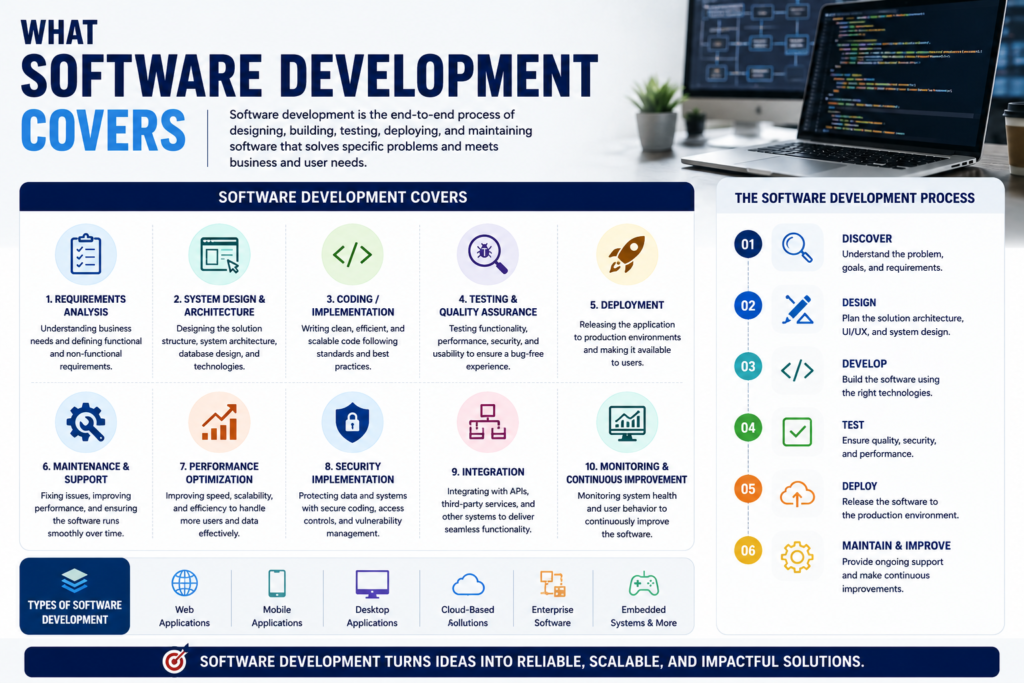
What software development covers
Software development is the process of writing code to implement defined functionality, usually within a defined software development process. A software development engagement typically begins with a specification — a document describing what the software should do — and ends with working code that does what the specification described. The input is requirements. The output is working software.
This is valuable and necessary, but it is only part of what a successful digital product requires. A software development team that receives a clear specification and builds exactly what was described has done its job. If what was described was the wrong thing to build, or if the specification missed critical user experience considerations, or if the architecture will not scale as usage grows, those problems are outside the typical scope of a software development engagement.
What product engineering adds
Product engineering encompasses the full lifecycle of building a digital product: problem definition, user research, product strategy, UX design, technical architecture, development, testing, deployment, monitoring, and iteration based on real-world usage. The difference from pure software development is that it starts from business and user problems, not from specifications, and ends not at deployment but at the point where the product is performing reliably and improving based on user behavior data.
A product engineering team asks questions that a software development team typically does not: who is this for and what problem does it solve for them? What does success look like and how will we measure it? What is the simplest version we can ship to validate the core assumption? How will this scale if usage grows by 10x? What are the failure modes and how do we handle them gracefully?
Key differences in practice
| Dimension | Software development | Product engineering |
|---|---|---|
| Starting point | Specification or requirements document | Business problem or user need |
| Scope | Writing code to implement defined functionality | Full lifecycle from strategy through scaled operation |
| UX involvement | Typically implements provided designs | UX is part of the engineering process, not an input |
| Architecture decisions | Often follows existing patterns or client direction | Architecture designed for the specific product’s scalability and performance requirements |
| Success definition | Code passes tests, deployment is complete | Product solves the defined problem and improves over time based on usage data |
| Post-launch involvement | Typically ends at deployment | Includes monitoring, iteration, and performance optimization |
| Business context | May not need deep understanding of business model | Requires deep understanding of business model and user behavior |
When a business needs software development
Software development is the right scope when the business has already done the product thinking and needs execution. A clearly defined specification, a finalized UX design, a chosen technical architecture, and a team that will own product decisions internally — in this context, a development team that can write excellent code and deliver against a defined scope is exactly what is needed. The thinking has been done. The building needs to happen.
Software development is also appropriate for well-defined, bounded technical tasks: building an integration between two existing systems, implementing a specific feature on an existing platform, migrating a database to a new structure, or developing a mobile app against a detailed design system. These are scoped implementations, not products in development.
When a business needs product engineering
Product engineering is the right approach when the business is building something new where the right solution is not yet fully defined, when the product will need to scale and evolve based on user behavior, when UX and architecture decisions will have long-term consequences that require integrated thinking, or when the initiative is strategic rather than operational.
For UAE businesses building a client-facing digital product — an app, a SaaS tool, a marketplace platform, a custom CRM system for their own use — product engineering is almost always the appropriate scope. The investment in the strategy, architecture, and UX phases consistently produces better outcomes than jumping directly to development without that foundation, even if it appears to add time and cost to the early stages of the project.
How to decide between product engineering and software development
The choice between product engineering and software development comes down to how well-defined the work already is.
- Is the problem clearly understood, or still being shaped? Unclear problems need product engineering.
- Is there a finished, validated design, or none yet? No design favors product engineering.
- Will the product need to scale and change with user behavior? Scaling favors product engineering.
- Is this a bounded task on an existing system? A bounded scope favors software development.
- Who owns product decisions — your team or the partner? If the partner, product engineering fits.
When several answers point toward open-ended, strategic work, product engineering is the safer scope. When the thinking is genuinely finished, software development delivers it efficiently.
Ready to build a digital product in the UAE?
DevedUp Business & Marketing provides product engineering services for UAE businesses, covering problem definition, UX design, technical architecture, development, and post-launch iteration. If you are building a digital product and want to ensure the thinking is done before the building starts, contact the team for an initial product scoping session.
Frequently asked questions
What is the difference between product engineering and software development?
Software development writes code to implement defined requirements. Product engineering addresses the full lifecycle from business problem and user need through architecture, development, and post-launch iteration. It includes the thinking before and after development; software development focuses on the development phase itself. Businesses building new digital products typically need product engineering. Businesses implementing defined features on existing systems typically need software development.
When should a UAE business choose product engineering over software development?
Choose product engineering when the solution is not yet fully defined, when UX and architecture decisions will have long-term product implications, when the product needs to scale and evolve based on user behavior, or when the initiative is strategically important to the business. Choose software development when the specification is complete, the design is finalized, and the task is implementing a defined scope with clear acceptance criteria.
Is product engineering more expensive than software development?
It often costs more upfront because it includes strategy, UX, and architecture before any code is written. But it frequently costs less over the full life of a product by avoiding the expensive rework that comes from building the wrong thing or an architecture that cannot scale. For a new digital product, the early investment usually lowers total cost and risk.
Can a project start as software development and move to product engineering?
It can, but it is usually harder than starting with product engineering. Retrofitting strategy, UX, and scalable architecture onto code that was built to a narrow specification often means significant rework. If a project is likely to grow into a real product, bringing that thinking in from the start is generally cheaper than adding it later.
Does a small UAE business need product engineering or just software development?
It depends on what they are building. A small business adding a defined feature to an existing site usually needs software development. A small business launching a new app, SaaS tool, or custom platform that must grow with its users is better served by product engineering, because the early strategy and architecture decisions shape everything that follows.