
Marketing teams in the UAE regularly produce two types of reporting: scheduled reports sent at the end of the month, and live dashboards that update in real time. Both involve data. Both claim to show performance. But they serve different purposes, and choosing the wrong format for the decisions you need to make can mean acting on stale information or, alternatively, reacting to daily fluctuations that have no strategic significance.
This guide compares marketing analytics dashboards and standard periodic reports, covering what each does well, where each has limitations, and how to choose the right tool for the specific decisions you are trying to support. It connects to analytics and reporting services, BI dashboards, CRM reporting, and the broader question of how Dubai and UAE businesses should structure their performance measurement systems.
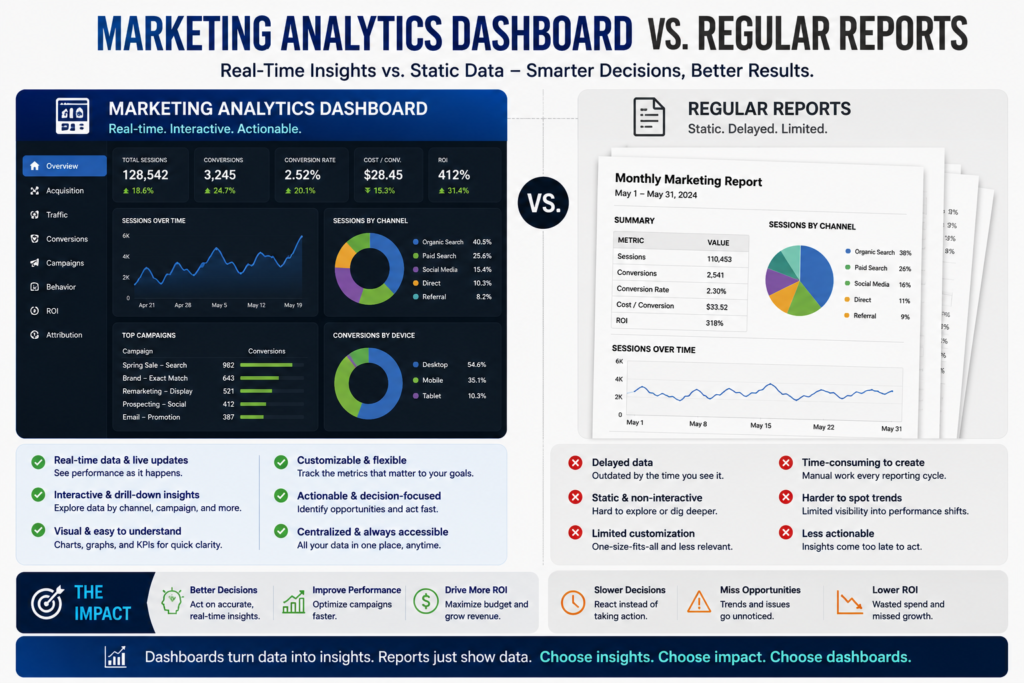
What is a marketing analytics dashboard?
A marketing analytics dashboard is a live, continuously updated business dashboard that displays marketing performance metrics. It pulls data from connected sources, typically Google Analytics, Google Ads, Search Console, and the CRM, and displays it in real time or near-real time. Anyone with access can check the dashboard at any point and see current performance without waiting for a report to be prepared.
Dashboards are designed for ongoing monitoring and quick answers to specific questions: how many leads did we generate this week? Which campaign is driving the most conversions today? How does this month’s organic traffic compare to last month? These are operational questions that benefit from immediate answers.
What is a standard marketing report?
A standard marketing report is a structured document produced at a defined interval, typically weekly or monthly, that summarizes performance over the reporting period, provides analysis and context, and includes recommendations for the next period. Unlike a dashboard, a report involves human interpretation: someone reviews the data, identifies what is significant, explains why performance changed, and recommends what to do next.
Reports are designed for strategic review and decision-making. They answer questions that require context and judgment, not just current numbers: why did cost per lead increase this month? What does the trend in organic traffic over the past six months tell us about the SEO investment? Should we reallocate budget from Display to Search next quarter?
Key differences between a marketing analytics dashboard and reports
| Factor | Marketing analytics dashboard | Standard marketing report |
|---|---|---|
| Update frequency | Real-time or near-real-time | Weekly or monthly |
| Human analysis required | Minimal — data is displayed, not interpreted | Significant — data is contextualized and explained |
| Best for | Monitoring, quick operational checks | Strategic review, budget decisions, trend analysis |
| Audience | Marketers and managers checking performance daily | Business owners, executives, strategic decision-makers |
| Context provided | Limited — shows what, not why | Strong — explains what, why, and what to do next |
| Action orientation | Alerts to issues, prompts investigation | Provides recommendations and next steps |
| Historical comparison | Often limited to preset date ranges | Can include long-term trend analysis |
| Preparation time | Minimal once built | Requires dedicated preparation time each cycle |
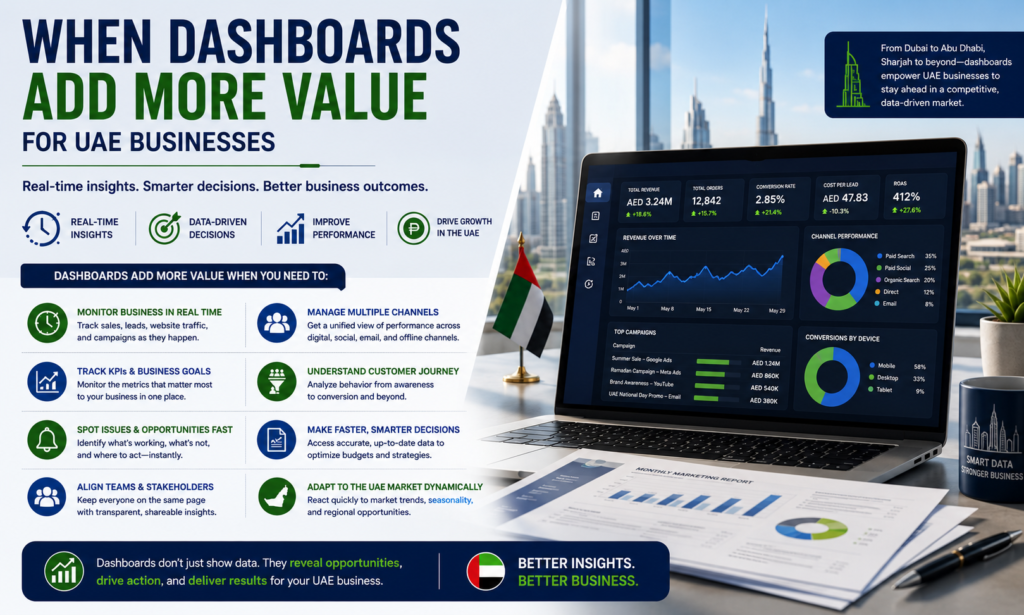
When dashboards add more value for UAE businesses
A marketing analytics dashboard is more valuable when the primary need is monitoring and immediate operational response. If you are running active PPC campaigns in Dubai with significant daily spend, a dashboard that shows real-time cost per lead, conversion rate by campaign, and budget pacing allows you to catch issues before they compound over days or weeks. If you have a sales team that needs to know daily lead volume from each source to prioritize follow-up, a live dashboard connected to your CRM provides that visibility without requiring anyone to pull a report.
Dashboards also reduce the time cost of routine performance checks. Instead of building a spreadsheet each week to check basic metrics, the dashboard provides that view on demand. A focused version of this is the marketing KPI dashboard for UAE businesses.
When reports add more value for UAE businesses
Standard reports add more value when the decisions being made require context, trend analysis, and interpretation. A business owner reviewing whether to increase the SEO investment for the next quarter needs more than current organic traffic numbers. They need the six-month trend, an explanation of which pages are gaining or losing visibility, how organic leads compare to paid leads in quality and close rate, and a recommendation on whether the current trajectory justifies the investment.
Reports also add value when the audience includes people who do not live in the data daily. Executives and board members reviewing marketing performance need context and narrative to make decisions, not raw metric feeds. A report that explains the story behind the numbers is more useful to that audience than a dashboard they have to interpret themselves. Our guide on marketing performance reporting covers what that report should track.
How to decide which format your Dubai or UAE business needs
The decision is not either/or. Most UAE businesses benefit from both formats serving different purposes. The practical framework is:
- Use a dashboard for: daily lead volume checks, campaign spend pacing, real-time conversion monitoring, and any metric where a delay in knowing would cause a meaningful problem
- Use a report for: monthly budget allocation decisions, quarterly channel strategy reviews, explaining performance changes to stakeholders, and any situation where the context behind the numbers matters as much as the numbers themselves
If your business currently has neither, a dashboard is usually the faster starting point since it requires only connecting your data sources rather than preparing periodic analysis. But do not mistake having a dashboard for having a reporting system — the strategic analysis that comes from well-prepared periodic reports is not generated automatically by any dashboard tool.
Ready to build the right reporting structure for your UAE business?
DevedUp Business & Marketing builds marketing reporting systems for Dubai and UAE businesses that include both live dashboards for operational monitoring and structured reporting for strategic review. Both connect to Google Ads, organic search, CRM, and analytics data to give a complete picture of marketing performance. If you want to understand what the right reporting setup looks like for your business, contact the team for an assessment.
Frequently asked questions
Is a marketing dashboard enough on its own for a UAE business?
For operational monitoring, yes. For strategic decision-making, no. A dashboard shows what is happening but rarely explains why or what to do next. Businesses that rely on dashboards alone tend to make reactive decisions based on current numbers without the trend context and analytical narrative that good periodic reports provide. Both formats serve different needs and work best together.
What is the difference between a KPI dashboard and a marketing report?
A KPI dashboard displays current metric values against targets in real time, designed for at-a-glance monitoring. A marketing report is a structured document that summarizes performance over a defined period, provides context for changes, and includes analysis and recommendations. The dashboard answers “where are we now?” The report answers “what happened, why, and what should we do next?” Our guide to the marketing KPI dashboard for UAE businesses covers the dashboard side in depth.
How do you build a marketing analytics dashboard in Dubai?
The most accessible tool for most Dubai businesses is Google Looker Studio, which connects to Google Ads, GA4, and Search Console for free and allows custom dashboard layouts. CRM data can be connected through native integrations or middleware tools. More complex requirements involving multiple data sources and advanced visualization may warrant Power BI or Tableau. The design should be driven by the decisions the dashboard needs to support, not by the range of metrics that are technically available to display. See how to build a marketing dashboard in Dubai for the full process.
Marketing analytics dashboard vs regular reports: which should a UAE business use first?
If a business has neither, a marketing analytics dashboard is usually the faster starting point — it only requires connecting data sources, and it immediately replaces manual spreadsheet pulls for routine checks. Regular reports come next, once there is enough trend data to analyze and a stakeholder audience that needs the narrative behind the numbers. The two are complementary: the dashboard for day-to-day monitoring, the report for monthly and quarterly strategy.
Can a marketing analytics dashboard and reports use the same data?
Yes, and they should. Both pull from the same connected sources — Google Ads, GA4, Search Console, and the CRM — so the numbers reconcile. The difference is presentation and purpose: the dashboard shows the live figures, and the report draws on the same figures to explain what changed, why, and what to do next. Using one shared data foundation prevents the common problem of a dashboard and a report disagreeing on the same metric.